Foreword By Jagan Chapagain
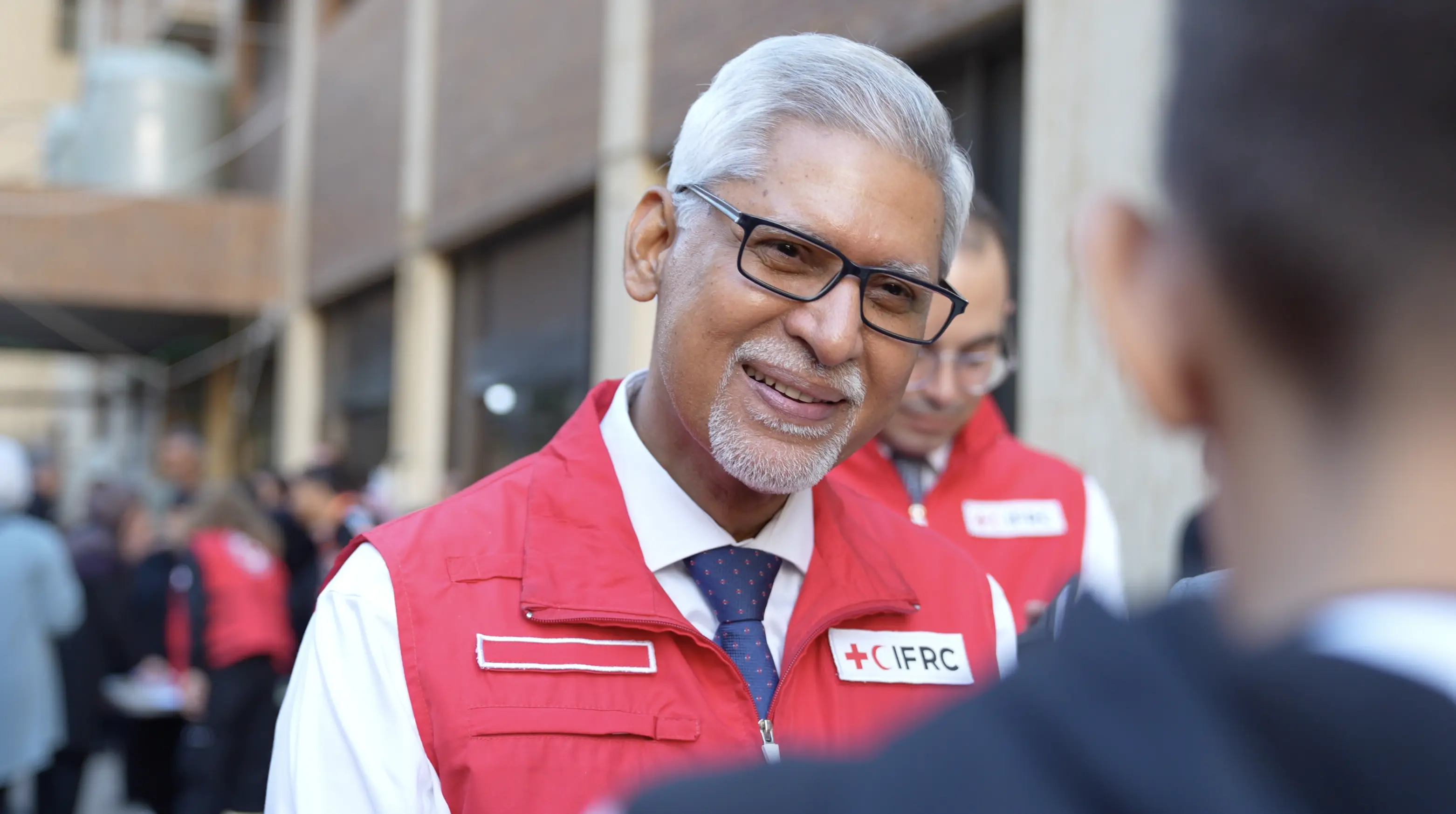
In every crisis I have witnessed – and in every response by the International Red Cross and Red Crescent network to a disaster, public health emergency, mass population movement or the humanitarian consequences of armed conflict – information is as essential as food, water and shelter. It guides people to safety, connects them to loved ones and gives them the knowledge to safeguard themselves and their communities.
But information can also cause harm. When false, misleading or deliberately manipulated, it can deepen fear, fuel discrimination, obstruct humanitarian access and cost lives. We have seen this too often: during disease outbreaks, when rumours outpace health advice; after disasters, when mistrust hampers aid delivery; and in armed conflicts, when inflammatory narratives escalate violence.
Harmful information is not new, but today it moves with unprecedented speed and reach. Digital platforms open vital channels for community voices, yet also provide fertile ground for lies. In this environment, trust is fragile.
In humanitarian contexts, harmful information flourishes where trust is weak. Trust strongly influences whether people believe harmful information, share it and spread it – shaping its impact and reach. Harmful information thrives on fear and uncertainty, weakening the relationships that make humanitarian access and action possible. Without trust, people are less likely to prepare, seek help or follow life-saving guidance; with it, communities act together, absorb shocks and recover more effectively. Maintaining trust is not optional – it is a humanitarian necessity.
The World Disasters Report 2026 calls on governments, humanitarian actors, media, technology companies and communities, to recognise that the trustworthiness of information is a matter of life and death. Just as we plan for logistics, shelter and health care in emergencies, we must also plan for the information environment. This requires investing in community engagement, prioritizing listening over speaking, building resilience against harmful narratives and consistently upholding humanity, neutrality, impartiality and independence in every interaction and message.
In 2024, 32 Red Cross and Red Crescent volunteers and staff were killed while on duty; in 2025, a further 26 lives were lost. This is a painful reminder of the risks borne by those who put humanity first, often in the most dangerous circumstances. Their deaths underscore the urgent need to protect humanitarian staff and volunteers, and to safeguard the space they need to save lives. Anything that deepens mistrust, fuels hostility or turns the emblem of protection into a target must be confronted with urgency. Honouring their memory compels us to meet this crisis with urgency and resolve.
Hope must also be part of our response. Harmful information thrives on fear and confusion, but hope – rooted in trust, solidarity and human dignity – can be just as contagious. Balancing threats with hope and fostering narratives of agency and possibility offers a vital counterforce. Around the world, communities respond to crises not only with resilience but also with creativity and compassion, often leading the way in finding solutions. By amplifying authentic stories and voices, we do more than counter falsehoods: we inspire action, strengthen trust and remind people that even in the darkest moments, there are paths forward.
The IFRC and its member Red Cross and Red Crescent Societies have always worked at the heart of communities, earning trust through presence, transparency and respect. In today’s information crisis, this role matters more than ever. Our commitment is clear and unwavering: act with humanity and based on evidence, uphold trust and put people in need first – so that in moments of fear and uncertainty, the voices that carry furthest are those that heal, aid and protect. Each of us has a role to play. By staying informed, questioning, verifying and amplifying only what is trustworthy and constructive, we strengthen the information environment and ensure that hope speaks louder than harm.

Synthesis - At crisis point: Countering harmful information, defending humanity
Harmful information is a pressing and pervasive challenge across all sectors of society, and a critical issue for organizations operating in humanitarian crises. Its impact on people in need, communities, responders, institutions and public trust in humanitarian action is profound.
This report uses the term ‘harmful information’ to focus on its impact and the responses – rather than rigid classifications, which are often politically charged and context dependent. While there is no universally agreed definition, for the purposes of this report, harmful information refers to information that has the potential to cause, contribute to or result in harm to an individual or entity . The term focuses attention on the harm itself, rather than on classifying the type of information being spread, which is often difficult to discern and constantly evolving.
Harmful information is often framed as an online phenomenon, but humanitarian crises have long been shaped by rumours, myths and propaganda spread through offline means – word of mouth, pamphlets, radio and television broadcasts, community meetings and other official or semi-official channels. These offline dynamics remain deeply influential, especially in contexts with limited digital access or low media literacy. Importantly, harmful information often moves fluidly between online and offline spaces, amplifying its reach and creating real-world consequences for individuals and communities.
In 2005, information was recognized as a form of disaster response. The concern then was one of omission – what people did not know – rather than the deliberate spread of damaging falsehoods. Twenty years on, that has changed. In 2026, this report frames harmful information as a de facto crisis : one that undermines access of populations to humanitarian aid, erodes trust, misleads communities, deepens vulnerabilities and destabilizes social cohesion. It is a crisis because it is chronic and evolving – escalating, mutating and persisting across time and contexts. Harmful information does not simply ‘strike’ once; it spreads, multiplies and compounds harm in many forms. It directly undermines the humanitarian sector’s ability to fulfil its core role: to alleviate suffering and protect life and human dignity, especially for people in the most vulnerable situations, while promoting respect for international laws, and upholding humanitarian principles and standards. Because harmful information can obstruct access, distort needs, fuel mistrust and even incite violence, it is no longer a peripheral concern. Responding to it is not optional – it is integral to protecting people and upholding humanitarian purpose.
Managing harmful information is no longer just a communication challenge; it is an operational and ethical imperative that demands a whole-of-society response, encompassing public policy, institutional policies, preparedness, education and social awareness. Meeting this challenge requires a shift in how the humanitarian sector prepares for, mitigates and actively counters harmful information. The sector is neither fully equipped to respond nor solely responsible, making collective response essential. Some 60 organizations provided written contributions to this report, underscoring how seriously its impacts are now regarded across the sector and beyond. Across consultations, all recognized the growing danger of harmful information and many voiced hopes that this report can help build understanding and drive action.
Historically, humanitarian standards and policies have often emerged in response to operational failures, access constraints or new technologies. Today, the challenge is no longer about the availability or accessibility of information, but about its reliability. This calls for clear sector-wide standards and guidance on how humanitarian actors should prepare for and respond to harmful information that are integrated into preparedness, risk assessment, protection and accountability frameworks and always adapted to local realities.
Today, as the humanitarian sector confronts a new wave of technological change – artificial intelligence (AI) – the stakes are rising once again. AI is accelerating the production and spread of information at unprecedented speed and scale, lowering the barriers to entry for malicious actors to manipulate content and influence opinion. Governance frameworks are struggling to keep pace.
Understanding how both information and technology are evolving is now essential to shaping effective responses to harmful information in humanitarian contexts. The scale and speed of harmful information today far exceed anything previously experienced. Navigating this flood of misleading, instrumentalized and targeted content has become critical to maintaining trust, protecting people’s safety and ensuring humanitarian response reaches people in need.
In this landscape of harmful information, the report places trust, proximity, community and resilience at the centre of its analysis.
This is particularly relevant in humanitarian contexts and within the information ecosystem: resilience cannot rest only on the shoulders of the people already most affected. It must be supported by broader systems that reduce vulnerability, enable equitable access to information and uphold rights. This requires investments in public trust, inclusive governance, meaningful accountability mechanisms and fair access to digital infrastructure and literacy. synthesissynthesissynthesissynthesis Without these foundations, resilience efforts risk becoming superficial – placing undue burden on the people and communities already most at risk.
Harmful information is not background noise
Harmful information is not background noise; it actively shapes how people understand crises, who they trust and whether they can access humanitarian assistance and protection. It influences safety and security both directly and indirectly. The struggle over harmful information is as much about cables as it is about content – the infrastructures and narratives that shape access, trust and power.
As the information ecosystem becomes increasingly complex, so too must the capacity to read it, respond to it and protect affected populations, individuals and organizations from its harms. Navigating this ecosystem is now a core part of what it means to act in humanitarian crises. It must inform how responses are designed and implemented, while also driving advocacy for broader systemic change.
The responsibility cannot rest solely with humanitarian organizations. Addressing harmful information requires enhancing resilience, building trust and deepening community engagement. It also demands coordinated, multi-stakeholder action – by governments, technology companies, media, communities and civil society organizations.
Confronting harmful information is not optional. It requires nothing less than systemic change. synthesissynthesis It is essential to protecting lives, upholding humanitarian principles and ensuring that humanity itself remains the strongest counterforce to manipulation, mistrust and division.
The task now is to ensure that the necessary safeguards, engagement, proximity, trust and resilience are not left to chance or profit, but are deliberately harnessed to protect people and enable principled humanitarian action.
Asks, aims and recommendations
Confront harmful information as a systemic humanitarian crisis that undermines safety, dignity and access. Integrate universally recognized rights, preparedness, accountability and transparency into crisis response, and act with the same urgency as for other humanitarian threats. Strengthen collaboration for sector-wide monitoring through rumour tracking, social listening and sentiment analysis.
Protect people:Prioritize reliable and accurate information in crisis preparedness, response and recovery to safeguard safety, dignity and access.
Detect early and adapt:Monitor narratives, perceptions and sentiment to enable coordinated, transparent and timely responses.
Safeguard humanitarian action:Shield staff, volunteers, affected populations and operations from harmful information, cyber threats and disruptions to critical infrastructure, while preserving trust and legitimacy.
For governments and policy-makers
-
Integrate harmful information management into crisis preparedness and response frameworks.
-
Invest in early warning and verification systems to deliver timely, reliable, life-saving information.
-
Uphold cyber norms and protect humanitarian organizations and critical infrastructure from malicious ICT use.
-
Establish clear legal and policy frameworks that support and protect humanitarian action from interference and harmful information campaigns.
For technology platforms
-
Prioritize rapid moderation and fact-checking in humanitarian crises – before, during and after crises – with effective escalation channels for humanitarian organizations.
-
Ensure tools function in low-bandwidth, multilingual and resource-constrained contexts.
-
Integrate purposeful friction into digital platforms – such as accuracy prompts, warning labels, ‘read-before-you-repost’ nudges, and slower sharing pathways for unverified content – particularly in the context of humanitarian crises, to limit the rapid spread of harmful information and encourage more deliberate, informed user engagement. Adapt algorithms to reduce amplification of harmful narratives targeting humanitarian organizations, principled humanitarian action and affected populations.
-
Report transparently on moderation actions, algorithmic adjustments and impacts in humanitarian contexts.
-
Co-design crisis-response protocols with humanitarian actors to ensure interventions are timely, context specific and aligned with internationally recognized rights and standards.
For humanitarian actors
-
Treat harmful information management as an operational risk – not just a communications challenge – integrated into humanitarian diplomacy and protection dialogue with states, regional organizations and multilateral forums; and into programmes, risk frameworks and preparedness planning.
-
Train staff and volunteers in rumour verification, digital literacy and safe information programmes; share insights across trusted organizations.
-
Strengthen monitoring by combining AI-enabled tools with human expertise for real-time detection, mapping of harmful information ecosystems and early warning; foster collaboration across the humanitarian sector to pool resources and capacity.
-
Document and analyse harmful information incidents systematically to build an evidence base for policy, adaptation and advocacy.
-
Engage communities transparently, co-creating messages with affected communities and reinforcing neutrality, impartiality and independence.
For communities and local leaders
-
Develop and sustain local rumour-tracking and verification systems.
-
Act as trusted intermediaries to strengthen solidarity, resilience and public confidence in humanitarian response.
-
Provide feedback loops to humanitarian actors and authorities on trust gaps and unmet concerns.
-
Ensure inclusivity, by making sure youth, minorities and people with disabilities, are represented in community information systems.
-
Foster dialogue, peer-to-peer engagement and communityled initiatives to counter harmful narratives and prevent polarization or stigma.
Trust, truth and preparedness
We are already living through an information crisis. Future emergency preparedness must include equitable access to reliable information, supported by early warning and systems that serve all communities, especially the most at risk. Harmful information is not only eroding trust in humanitarian action, it is fuelling societal division and undermining cooperation at a time when unity is urgently needed to face global challenges.
Trust is critical to the legitimacy, effectiveness and acceptance of humanitarian action. This was strongly emphasized at the 2019 International Conference of the Red Cross and Red Crescent Movement which recognized synthesissynthesis that trust in principled humanitarian action is indispensable to serving at-risk people and encouraged all members of the conference to act to preserve and develop this trust. 1 Crucially, trust in humanitarian action does not rest solely on humanitarian actors. It also depends on a conducive environment – one in which principled, effective and accountable action is actively supported. Such an environment is shaped by the legal, political and operational frameworks established by states and other actors. This includes respect for humanitarian principles, flexible and needs-based funding, protection of humanitarian access and clear delineation of roles and responsibilities of various actors.
In an era of increasing volumes of harmful information and rising public distrust, humanitarian organizations face a growing challenge: principled, fact-based communication often struggles to compete with emotionally charged narratives, polarizing content and opinion-driven discourse. Even when – perhaps especially when – grounded in evidence and neutrality, humanitarian messaging is often drowned out by louder, more emotionally resonant voices, particularly online. This creates a significant perception challenge. Trust and integrity may be questioned and principles seen as detached from realities or lacking empathy.
The result is a trust and perception problem: neutrality, facts and rationality are increasingly misunderstood or mistrusted. When emotion and polarization drive engagement, even well-intentioned communications risk being reframed as political or partial. This distorts how communities perceive humanitarian work and undermines the credibility of those committed to principled humanitarian action. Navigating this landscape requires sustained community engagement, especially offline, where dialogue can foster proximity and trust. Digitally, it may also involve recognizing the limits of engagement and, in some cases, closing comment sections or refraining from responding when dialogue cannot be conducted in good faith.
Among the seven Fundamental Principles of the International Red Cross and Red Crescent Movement, 2 neutrality and impartiality are often the least understood and provoke the most controversy. This is somewhat ironic, given that neutrality’s purpose is precisely to avoid entanglement in controversy. At its core, neutrality is not an end in itself, but a method to preserve trust and access in polarized or politicized environments. Impartiality, meanwhile, demands that aid be provided solely based on need, without discrimination of any kind. Together, these principles safeguard the Movement’s ability to serve at-risk populations equitably and without bias.
In such a fragmented and contested information space, the voices of affected populations risk being drowned out, distorted or co-opted. Trust cannot be demanded; it must be built through repeated action, transparency, accountability and integrity. Resilience against harmful information requires more than just correcting falsehoods, it requires sustained engagement, openness and meaningful participation. Humanitarian organizations must also actively communicate who they are, what they do, their impact and why they act – making a clear, compelling case for principled humanitarian action and for preserving a neutral and impartial humanitarian space, free from political influence. Despite the barriers posed by polarized perceptions, principled humanitarian organizations can maintain – and even rebuild – trust and acceptance in the face of harmful information. Looking ahead, a critical question is whether trust and proximity at the community level can serve as a firewall against the spread or impact of harmful information.
Responding to harmful information requires more than increasing the volume of communication or correcting falsehoods. These approaches alone do not build trust and can even backfire, particularly during armed conflicts, political unrest or situations marked by discrimination. Effective responses go beyond countering narratives; they focus on disrupting harmful information and strengthening resilience at both organizational and societal levels. Trust is built through proximity, understanding, access to services and a sense of shared ownership3. Crucially, it cannot be created in the middle of a crisis; it must be cultivated over time.
Asks, aims and recommendations
Place trust at the centre of humanitarian action by ensuring that the principles of rights, dignity, inclusivity, accountability, transparency and feedback guide how organizations communicate and engage with communities.
Reduce uncertainty through timely, transparent and consistent communication and engagement before, during and after crises.
Strengthen legitimacy and accountability by aligning with community priorities and tracking trust.
Protect staff and volunteers with safeguards, skills and inclusive engagement to operate safely in contested information spaces.
Empower communities: Build two-way feedback and participation systems that allow people to voice concerns, influence decisions and counter harmful narratives.
For governments and policy-makers
-
Establish rights-based policy frameworks that safeguard access to reliable information in humanitarian crises.
-
Embed trust-building into crisis preparedness and response plans.
-
Invest in early warning and monitoring systems to detect and counter harmful narratives.
-
Support National Societies in their auxiliary role ensuring independence, impartiality, neutrality and integrity are respected.
-
Ensure rapid rebuttals of falsehoods that threaten humanitarian access, action and security.
For technology platforms
-
Detect and mitigate harmful content that undermines humanitarian action and trust.
-
Share relevant data and insights safely with humanitarian actors to support real-time response.
-
Ensure moderation, fact-checking and AI tools work in low-bandwidth, multilingual environments.
-
Collaborate with humanitarian actors on verification and labelling mechanisms to amplify credible content.
For humanitarian actors
-
Develop policies, guidelines, standards and metrics (e.g., Community Trust Index and community engagement and accountability) to measure and track trust and harmful information, and guide responses.
-
Embed trust as an operational asset across preparedness, response and recovery.
-
Communicate transparently and inclusively, correcting falsehoods rapidly and co-creating messages with communities.
-
Train staff and volunteers in rumour management, digital safety (including protection from online harassment) and culturally sensitive engagement.
-
Strengthen real-time analysis of and response to community feedback, adapting visibly to concerns, demonstrating impact and sharing lessons learned to build collective resilience.
For communities and local leaders
-
Act as trusted intermediaries by amplifying verified information and countering rumours.
-
Partner with humanitarian actors to co-create rumour-tracking and verification systems.
-
Sustain trust through dialogue in schools, faith institutions and community centres.
-
Engage in participatory feedback and research to ensure that responses reflect local priorities.
Navigating humanitarian action in a post-trust information era
Humanitarian action now unfolds within a highly contested information environment, characterized by Barclay as a ‘post-trust culture,’ 4 where truth plays a diminished role in shaping human decision-making. In this environment, technology amplifies and instrumentalizes information, allowing harmful narratives to spread quickly, especially where reliable information is scarce.
Climate change, vaccine hesitancy and migration are among the issues on which harmful information thrives, crossing borders and continually being reshaped by local contexts, narratives and political agendas. These same issues also contribute to humanitarian crises. Humanitarian organizations therefore face a delicate balancing act: they must meet urgent needs while navigating what can and cannot be said, avoiding controversies that could inflame tensions or compromise perceptions of neutrality.
At the heart of this challenge lies the power of narrative. Narratives shape how people interpret information and decide whom to trust and whether to engage with humanitarian actors. They are reinforced by lived experience, public discourse, media coverage and digital engagement. When there is a gap between dominant narratives and people’s daily realities, trust erodes and alternative or harmful narratives often emerge. These narratives frequently define identity by portraying certain individuals or groups as outsiders, threats or illegitimate – as the ‘other’. Such framing generates fear, fuels exclusion, dehumanizes and normalizes hostility. For example, displaced populations may be cast not as victims of a crisis but as threats to national stability or competition for scarce resources. In this way, narrative shapes perception and the notion of the ‘other’ shapes belonging – who is trusted or untrusted, legitimate or illegitimate.
Narratives also simplify complexity, evoke emotion and may weaken social cohesion. synthesissynthesis In today’s information ecosystem, humanitarian organizations must contend not only with physical threats but also with digital and cyber ones. They are increasingly framed as ineffective responders, political tools or even foreign agents. This makes it harder to ensure that accurate, trusted information reaches the people who need it most and can be distinguished from harmful content. In contested or sensitive environments, people may instead turn to online communities for answers – even when these communities amplify harmful messaging driven by actors lacking expertise and clear political or economic agendas.
Malicious actors exploit people’s limited capacity to process information by amplifying feelings of fear, grievance and crisis. This does not just create short-term confusion; it entrenches long-term mistrust. The consequences are real. Harmful narratives influence how communities perceive risk, how they respond during emergencies and how they prepare for future shocks, including disasters. In moments of crisis, harmful narratives can fuel denial, panic or resistance – ultimately undermining life-saving interventions.
Asks, aims and recommendations
Strengthen global cooperation on platform accountability, AI governance and the protection of humanitarian information by embedding human rights, preparedness, accountability and collaboration into legal and policy frameworks. Invest in community-led resilience, preparedness and feedback systems that empower all community members, ensure access to information and protect vulnerable populations – applying a clear rights-based approach in practice.
Prevent harmful information from undermining humanitarian access and action.
Strengthen community resilience: equip communities and volunteers with trusted information, preparedness tools and locally grounded strategies to counter harmful narratives.
Advance policy coherence by embedding humanitarian perspectives in digital and AI governance.
States and policy-makers
-
Champion the protection of humanitarian information within legal and policy frameworks for AI governance and platform accountability.
-
Counter harmful narratives that stigmatize communities and/or principled humanitarian organizations, while avoiding the politicization of humanitarian action.
-
Reaffirm the importance of safe, unhindered humanitarian access and promote understanding of humanitarian mandates, including the auxiliary role of National Societies as independent yet recognized partners to public authorities.
-
Engage with humanitarian actors to ensure timely, accurate and locally relevant communication strategies that support humanitarian action.
-
Ensure national information laws and policies comply with international law.
Technology platforms
-
Provide locally adapted tools, including multilingual translation, culturally relevant fact-checking and accessibility features.
-
Amplify verified humanitarian information in crises by engaging with humanitarian and community actors.
-
Monitor how humanitarian narratives are reshaped locally and mitigate harmful reinterpretations.
-
Adapt and/or cool algorithms during crises to reduce amplification of harmful narratives.
-
Strengthen partnerships with humanitarian organizations and community media to ensure reliable, timely and life-saving messages reach affected populations.
Humanitarian actors
-
Co-create inclusive, locally relevant messages with communities, journalists and trusted influencers for contextual, cultural and linguistic relevance.
-
Monitor perceptions of humanitarian action and adapt real-time messaging across online and offline channels.
-
Build resilience through training, capacity building and embedding harmful information management in humanitarian diplomacy, risk and behaviour change.
-
Document and share insights and lessons learned on combating harmful information to support continuous adaptation and strengthen collective resilience.
Community and local leaders
-
Contextualize and disseminate verified humanitarian information in ways that reflect community priorities.
-
Use peer networks, dialogue and community-led initiatives to challenge harmful information.
-
Identify trust gaps and communicate concerns directly to humanitarian actors and authorities.
Navigating a hostile information landscape
Harmful information is not an abstract threat: it has direct, tangible consequences for humanitarian operations, often in ways that undermine trust, disrupt access and endanger both staff and affected communities. From false accusations to targeted campaigns, humanitarian actors across the globe are increasingly confronted with the operational fallout of distorted narratives. These impacts are being felt in armed conflicts, during public health emergencies, in disaster responses and in the everyday functioning of humanitarian organizations, whether local or international.
Virtual spaces are not neutral arenas for dialogue. Digital platforms have become battlegrounds where trust and truth are deliberately undermined and where individuals, communities and even nations are subjected to harmful information attacks. In this dense, volatile space, the boundaries between truth and falsehood blur. Humanitarian narratives must contend with an overwhelming flood of emotional, politicized and sometimes instrumentalized content.
A decade ago, there was a sense that the “information flows cannot be controlled nor do they need to be”. 5 This perspective reflected an earlier digital era, when social media platforms were emerging and user-generated content largely reflected the goodwill of individuals, rather than the calculated harmful intent of malicious actors. At the time, it was a progressive call for greater participation, transparency and accountability. But today’s landscape is profoundly different. The question is no longer whether information should be regulated, but what should be addressed, how, by whom and with what safeguards – particularly in terms of protecting fundamental rights and freedoms. Striking this balance has become one of the central challenges of the current era.
At its core, humanitarian action is about meeting the needs of people in crises, not securing visibility or reputation of the organizations delivering it. Yet, when the spotlight shifts from communities and onto organizations – through unmerited criticism or targeted harmful information – their safety and ability to operate effectively is under threat. Increasingly, harmful narratives shape public and societal perceptions of humanitarian action, constrain access, erode trust and shrink the operational space for principled humanitarian action. While legitimate scrutiny is vital for accountability and improvement, it must be distinguished from deliberate distortion or harmful disinformation designed to delegitimize and obstruct humanitarian efforts. The consequences, as highlighted throughout this report, are stark: diminished access, reputational damage, emotional strain and heightened security threats to staff and volunteers, operational delays and loss of public trust.
These dynamics underscore the urgent need for more coordinated and systemic responses. Addressing harmful information requires sector-wide collaboration and investment, and proactive engagement with those who shape and influence the information environment – not least governments and technology companies (see Chapter 5 for a detailed examination of their role).
Above all, this landscape raises urgent questions that no single organization can resolve alone: the challenges transcend the mandate or influence of any individual organization. The dilemmas demand collective reflection and shared approaches:
-
Neutrality versus harmful narratives: When dehumanizing or discriminatory narratives spread – sometimes by state or political actors – should humanitarians remain silent to preserve neutrality and access, or speak out to prevent harm?
-
Debunking versus risking access: Should falsehoods be publicly challenged, even if doing so risks undermining neutrality or operational access? How can humanitarian actors respond without being drawn into politicized or polarized debates?
-
Integrity versus polarization: In fragmented and hostile information environments, how can humanitarian actors protect the integrity of their messaging and maintain trust without being co-opted, misrepresented or silenced?
-
Collective action versus fragmented responses: What partnerships, mechanisms and international norms are needed to protect humanitarian organizations from information attacks? Should the sector advocate collectively for stronger platform policies and governance frameworks to safeguard humanitarian space?
-
Speak out versus silence: When harmful narratives systematically target groups in vulnerable situations – such as migrants – and are driven by state or political interests, what space remains for humanitarians to respond? How can they challenge such narratives without compromising neutrality? At what point is silence perceived as tacit approval of discriminatory or dehumanizing narratives, and when does silence risk becoming complicity?
Together, these dilemmas underscore the urgent need for the humanitarian sector to find collective strategies that preserve principled humanitarian action while protecting at-risk groups and safeguarding trust in an increasingly hostile information environment.
Asks, aims and recommendations
Treat harmful information as an operational risk by embedding preparedness, accountability and transparency into all phases of humanitarian action, from early warning to recovery – and measure its human, social and operational harms as rigorously as physical impacts.
Safeguard humanitarian access and action by recognizing harmful information as a systemic risk.
Protect operations, staff and community trust: integrate harmful information analysis and response into all phases of humanitarian action.
Build resilience by resourcing responses and systematically measuring harms to inform evidence-based action.
States and policy-makers
-
Build societal resilience through public information literacy and awareness initiatives.
-
Integrate harmful information risks into disaster management and crisis-response frameworks.
-
Support mechanisms to identify and address harmful information incidents that endanger civilians or disrupt humanitarian operations, ensuring the mandates of principled humanitarian actors are respected.
-
Support international cooperation and uphold cyber norms to protect humanitarian action and critical services.
-
Establish flexible funding lines for harmful information response, with priority for building local resilience and community-led rumour tracking.
Technology platforms
-
Adapt or ‘cool’ algorithms during humanitarian crises to reduce amplification of harmful narratives.
-
Prioritize authoritative information from trusted humanitarian, health and local actors to deliver timely and life-saving guidance.
-
Implement crisis protocols that temporarily re-weight algorithms in favour of safety and reliability over optimizing engagement.
-
Collaborate with principled humanitarian actors to design context-specific, transparent interventions on platforms that respect users’ human rights and protect the safety of crisis-affected populations.
-
Ensure independent oversight to balance freedom of expression with the need to prevent harm to civilians, humanitarian actors and operations.
Humanitarian actors
-
Integrate harmful information monitoring into programmes, assessments and early warning systems.
-
Document, analyse and share actionable insights and lessons learned from harmful information incidents and their operational impacts to inform real-time adaptation and long-term resilience, without impeding principled humanitarian action.
-
Strengthen staff and volunteer capacity to identify, document and respond safely to harmful narratives. Strengthen internal communication systems to ensure staff and volunteers are informed, coordinated and able to respond safely and consistently to harmful narratives while upholding humanitarian principles.
-
Invest in multilingual monitoring, two-way communication, rapid verification systems and partnerships with trusted local moderators.
-
Facilitate regional research hubs to strengthen monitoring, measurement and evidence-based assessment of harms.
-
Strengthen collaboration and training for humanitarian staff and volunteers on digital threats, information and media literacy, and narrative analysis.
Community and local leaders
-
Co-create rumour-tracking and feedback systems to detect harmful information early.
-
Verify and amplify accurate information through trusted local channels.
-
Document harmful information incidents that affect safety, services or access.
-
Foster dialogue and peer-to-peer engagement that reduces stigma, fear and division.
A collective responsibility for preserving principled humanitarian action
Harmful information is borderless, adaptive and often directed at the people most at risk. Algorithmic systems amplify its spread, while global disparities in data governance, AI capacity and political and societal polarization intensify its reach. Effective responses require greater algorithmic transparency on how content is sorted, ranked, amplified and targeted, combined with approaches that protect privacy, dignity and authenticity.
Humanitarian crises – from pandemics to armed conflict – create fertile ground for harmful information. Information related to the COVID-19 pandemic exposed both the speed of harmful information spread and the cost of delayed action. Meeting the challenges of identifying, preventing and mitigating harmful information requires a systems approach and urgent, cross-sectoral action. Fragmentation between humanitarian actors, digital rights advocates and the technology communities must be bridged. This includes creating space for emerging questions, fostering diverse and underrepresented perspectives, and prioritizing principles and accountability. Strong, forward-looking partnerships are essential, not only to shape governance frameworks, but to influence the design and deployment of tools used to navigate this rapidly evolving landscape.
Determining what constitutes harmful information is essential for any entity seeking to develop a strategic response aligned with risk management. The impact of harmful information depends on several variables including its scope (scale and severity), duration, magnitude of the incident and the resilience of the affected individual, organization and broader context. Harm may result directly from the incident or indirectly, with distinctions often based on the degree of certainty that the information caused the outcome. A single incident can generate multiple forms of harm, classified as direct (primary) or indirect (secondary or tertiary). These may include physical, psychological, societal and deprivational harms. The effects of harmful information are often disruptive and multidimensional, manifesting across several categories simultaneously.
One of the most contested areas in defining harmful information is the boundary between legitimate political dissent and incitement. In some contexts, this line is blurred, raising serious concerns about freedom of expression. Content may be labelled as dissenting, destabilizing or inciting violence, particularly during times of crisis or internal tension. The challenge is ensuring that measures designed to counter harmful information are not used as a pretext for silencing dissent. Clear safeguards are needed to distinguish between speech that challenges authority and speech that genuinely threatens public order, safety and human dignity.
Resilience must be built at every level – individual, institutional and societal – drawing on community trust, local knowledge, behavioural science, digital and information literacy. Evidence shows that simple interventions, such as digital prompts6, can reduce the sharing of false content, underscoring the value of pairing regulation with context-specific solutions. Governments, platforms, civil society and researchers must work together to test and scale what works. This underscores the importance of pairing regulation with behavioural science and practical interventions that are context specific. Governments, platforms, civil society and researchers must work together to test what works, for whom and in which context7.
For the humanitarian sector, strengthening cross-sector engagement is essential – not only to ensure the flow of trustworthy information but also to identify and respond to harmful information. Disruption alone is not enough. Responding effectively requires a collective effort such as building on that initiated for global health security during the COVID-19 pandemic.
Ultimately, states must act. As underscored in the Movement’s Appeal to States, addressing harmful information is now central to principled humanitarian action. Trusted information may not be water, food or shelter but it is imperative to accessing all three, as well as to ensuring safety, dignity and autonomy.
We appeal to States to take all appropriate measures to prevent, stop and remedy any abuse, pressure, misinformation, disinformation and dehumanizing rhetoric, through social media or otherwise, that harms the physical, psychological or reputational wellbeing of people in vulnerable situations and the staff and volunteers of the Movement components serving them.”
2.webp)
Asks, aims and recommendations
Balance the protection of humanitarian space, the safety and dignity of affected populations and the integrity of humanitarian operations with freedom of expression by building rights-respecting, transparent, accountable and resilient information ecosystems.
Ensure laws and policies protect principled humanitarian action and safeguard trusted and reliable information.
Hold platforms accountable for measures that protect principled humanitarian action and implement transparent, rights-respecting crisis protocols that safeguard affected populations and humanitarian personnel.
Embed harmful information analysis into humanitarian operations to safeguard trust, access and principled humanitarian action.
Engage affected communities in information strategies and work with digital platforms to ensure timely, accurate and safe information flow.
Build trusted information ecosystems through digital and media literacy, local dialogue, initiatives that counter polarization and ongoing monitoring to evaluate and adapt interventions.
States and policy-makers
-
Adopt rights-respecting regulations to counter harmful information while safeguarding humanitarian action and trusted information.
-
Coordinate with humanitarian actors to ensure laws and regulations protect and respect principled humanitarian action.
-
Integrate risks from harmful information that could affect principled humanitarian action into negotiations, frameworks and operational planning.
-
Respect and support the independence of National Societies in their auxiliary role ensuring they can operate without interference.
Regulators and technology companies
-
In humanitarian crises, report transparently on harmful content removal, moderation practices and algorithmic adjustments to ensure trust, accountability and prevent harm to people in need and humanitarian personnel and volunteers.
-
Collaborate with principled humanitarian actors to design localized mitigation tools such as fact-check bots, verified information hubs and multilingual content.
-
Strengthen enforcement against coordinated harmful information campaigns targeting principled humanitarian organizations and the safety and dignity of affected communities, humanitarian personnel and volunteers.
-
Develop and apply rights-respecting crisis-response protocols in collaboration with humanitarian actors and share relevant data with humanitarian organizations and research hubs to support trusted, principled action.
Humanitarian actors
-
Embed trusted information as essential for principled humanitarian action and for combating harmful information into humanitarian standards and operational frameworks.
-
Share evidence of harmful information trends with regulators and platforms in ways that respect data protection rules and support principled humanitarian action to mitigate harmful information, protect humanitarian action, and safeguard affected populations, humanitarian personnel and volunteers.
-
Partner with local journalists, fact-checkers and trusted content creators to amplify accurate, contextualized and life-saving information for populations in need.
-
Strengthen community engagement by integrating media literacy, information resilience and feedback mechanisms into humanitarian programming, ensuring communities can access, understand and act on reliable information.
Communities and local leaders
-
Promote community-based media and independent journalism to provide timely, accurate and accessible information.
-
Lead digital and media literacy initiatives to build critical thinking and resilience to harmful information.
-
Act as trusted intermediaries by disseminating verified information through local channels such as radio, schools and faith institutions.
-
Facilitate dialogue to counter polarization, address stigma and prevent harmful information from escalating into violence.
From communication to collaboration
In an era marked by record-breaking climate extremes, a growing number of disasters and emergencies and shrinking humanitarian budgets, the imperative to act to prepare before crises strike has never been more critical. But today’s emergencies are not only physical – they are also informational. Harmful information can amplify fear, erode trust and disrupt preparedness and response efforts. It exacerbates existing vulnerabilities and tensions, compounding risks in contexts where trust is already fragile. As with disaster risk reduction, addressing harmful information requires a fundamental shift from reactive response to proactive resilience. This means supporting locally led action, investing ahead of crises and tackling the root causes of risk at the heart of humanitarian strategies.
Just as physical disasters need not be deadly or destabilizing if communities are supported to anticipate, withstand and adapt, the same holds for harmful information. The challenge lies in scaling and sustaining locally grounded solutions by embedding information resilience into humanitarian programming. Strengthening resilience through integrated, cross-sectoral approaches shifts the focus from reacting to harmful information crises to managing risks and building communities able to withstand them.
Addressing harmful information effectively requires more than delivering messages, it demands a fundamental shift in mindset: from disseminating information to enable participation and agency. Too often, communication efforts are designed as one-way flows, with external actors determining what information is relevant or important, how it is framed and who gets to speak. This top-down approach not only risks reinforcing existing power imbalances but also overlooks the insights, lived experiences and priorities of people in need.
In contrast, when communities are actively involved in shaping the narratives, identifying risks and driving the response, they are no longer passive recipients of information but co-creators of solutions. Building resilience to harmful information is not simply about correcting falsehoods – it is about restoring trust, deepening dialogue and empowering people to navigate information environments.
This shift toward shared agency requires:
-
Recognizing and supporting trusted local actors , from youth leaders and women’s groups to religious figures and community media, who are best positioned to engage meaningfully with their peers and people in need.
-
Investing in local information ecosystems – community radio, local journalists, digital access points, feedback mechanisms – that provide continuous, context-relevant communication before, during and after crises.
-
Embedding media and digital literacy into humanitarian programming , enabling individuals to assess and challenge harmful content and engage in informed decision-making.
-
Creating space for participatory content creation , allowing communities to express their perspectives in formats that resonate culturally and emotionally, whether through storytelling, theatre, radio or social media.
-
Safeguarding community engagement , ensuring that participation does not expose individuals to risks, especially in politically polarized or fragile environments.
As highlighted throughout this report, harmful information is not just a communications challenge, it is a threat to humanitarian access, acceptance and security, and as such requires a whole-of-organization and whole-of-society approach. Addressing it requires systems thinking, sustained collaboration and a willingness to share control. Just as humanitarian actors need to fully embrace the localization agenda in service delivery, the same commitment is needed in response to harmful information: to listen, co-create and build responses grounded in trust, transparency and mutual accountability.
The critical elements of strategic communication in a digital age – the right audience, right message, right time and right messenger – are especially important in efforts to counter harmful information. These four components are deeply interdependent.
Ultimately, resilience to harmful information is not achieved through better messaging – it is built through better relationships. By investing in local voices, community ownership and inclusive approaches, the humanitarian sector can move beyond reactive counter-narratives and toward a more sustainable, principled and people-centred response. Shifting toward shared agency means recognizing that trust and legitimacy come not from broadcasting facts, but from meaningful participation, dialogue and mutual accountability.
Asks, aims and recommendations
Put communities at the heart of information resilience by investing in inclusivity, accountability and collaboration. This includes supporting feedback mechanisms, local verification and community-owned narratives that strengthen locally trusted information systems, enabling principled humanitarian action and more effective crisis response.
Strengthen principled humanitarian action by embedding community voices and verification systems within information ecosystems.
Ensure humanitarian responses are principled and accountable by using information and narratives grounded in local perspectives, reflecting diverse community voices, and promoting trust and inclusivity in decision-making.
Strengthen operational resilience by ensuring diverse voices guide humanitarian decisions and responses.
States and policy-makers
-
Resource community-led verification and communication by funding rumour-tracking, independent journalism and inclusive channels (radio, digital access points, offline formats) in local languages.
-
Strengthen information ecosystems critical to humanitarian action by investing in local capacity and information literacy, and promoting stronger responses from technology platforms and proactive measures to counter harmful information.
-
Empower trusted local actors – including youth groups, women’s networks and community media – through partnerships, resources and safeguards, and integrate them into local information ecosystems to support verification, feedback and principled humanitarian action during crises.
Humanitarian actors
-
Build accountability and trust through co-created messages, community feedback loops, transparent reporting and joint review with communities – ensuring that engagement respects humanitarian principles and avoids politicization.
-
Establish early warning and rapid response systems to monitor information patterns and narratives that affect humanitarian action, amplify trusted messengers and enable timely responses at the local level – while safeguarding privacy.
-
Support community-led content by enabling safe, independent storytelling and locally relevant information in local languages, with robust safeguarding measures to protect contributors and ensure inclusion.
-
Strengthen local journalists and media through capacity building for timely and accessible multilingual content across both online and offline platforms – while maintaining neutrality and avoiding alignment with political agendas – to support principled humanitarian crisis response and a resilient local information ecosystem.
-
Measure and learn by tracking trust, participation quality, the inclusion of marginalized voices and timeliness of corrections – using anonymized or aggregated data – and share lessons learned to improve principled humanitarian responses across contexts.
-
Ensure strategic communication in humanitarian contexts aligns the right audience, message, timing and messenger, recognizing their interdependence, to effectively counter harmful information and support principled, context-sensitive responses.
Communities and local leaders
-
Generate and amplify community-owned narratives that build trust and support principled humanitarian action during crises.
-
Act as trusted intermediaries facilitating – where required – dialogue between humanitarian actors, authorities and populations in need to ensure two-way accountability and respecting and supporting the role of principled humanitarian organizations.
-
Safeguard inclusivity in local information systems so that diverse voices – including groups that are marginalized – are represented and heard.
Principled action requires more than declarations
In an information environment distorted by rumour, manipulation and politically charged content, trust in humanitarian actors is increasingly fragile. Harmful information can undermine the perceived impartiality, neutrality and independence of humanitarian actors, fuel suspicion among communities and endanger staff, volunteers and the people they serve. In the sentiment-driven economy of social media and now AI, principled humanitarian action is easily misunderstood or misrepresented – especially when it fails to align with dominant political or emotional narratives. In such settings, the consistent application of humanitarian principles becomes not only more difficult but more essential.
There is a growing strategic vulnerability: humanitarian action is designed to be deliberate, impartial and context specific. Digital information, by contrast, is immediate, emotional and virally amplified. This creates a dangerous speed mismatch. Humanitarian actors generally take time to verify facts, assess needs and coordinate responses. Harmful narratives and outrage, by contrast, travel in seconds – unconcerned with humanity, neutrality, accuracy, proportionality or consequence.
Declaring adherence to the fundamental and humanitarian principles is not enough. Access to affected populations and acceptance of humanitarian actors must be continually earned. They depend on humility, principled behaviour, operational effectiveness and impact, and timely, transparent engagement and communication. Words must align with actions. Without this alignment, safe and sustained access – essential for principled humanitarian action – becomes increasingly difficult to secure.
Upholding humanitarian principles today means more than silent adherence. It requires actively promoting, explaining and embodying them in every context – including the digital sphere, where harmful information and politicized narratives quickly erode trust.
In an era of accelerating technology, human responses such as empathy, respect and moral restraint are more critical than ever. As philosopher Jonathan Glover observed, these moral resources help people exercise self-restraint, respect the dignity of others and care for their suffering and well-being. He described them as “the tendency to respond to people with certain kinds of respect – as members of our community, as human beings” and as “sympathy – caring about the miseries and the happiness of others, and perhaps feeling a degree of identification with them.”8
Today, harmful information is not a communication challenge; it is a threat to humanitarian action and requires a whole-of-society and whole-of-organization approach. Where humanitarian communicators once focused on facilitating information sharing with affected communities and on engaging donors, they are now increasingly tasked with detecting, responding to and trying to mitigate harmful content. Yet many organizations remain underprepared for the scale and sophistication of today’s information threats.
Technology can undoubtedly streamline humanitarian operations, but it also raises difficult questions about whether it risks dehumanizing humanitarian action – replacing listening with automation or judgement with algorithmic logic. Writing in 1999, long before today’s digital transformation, Glover presciently concluded in his book Humanity :
“It is too late to stop the technology. It is to the psychology that we should now turn.” 9
Glover is saying that the danger lies less in the machines themselves than in how human psychology responds to the power they give us. The survival of humanity depends not on stopping technology, but on understanding and strengthening the moral psychology that restrains its misuse. In today’s landscape, where trust is fragile and harmful information can undo principled efforts in moments, this call is more urgent than ever. Just as Glover emphasizes that moral restraint and psychology are central once technology cannot be stopped, the Movement Appeal to States underscores that humanitarian principles – humanity, neutrality, impartiality and independence – serve as psychological and ethical safeguards in complex and high-pressure environments. In a polarized information landscape, where narratives can manipulate perception and inflame divisions, adherence to these principles acts as a moral and operational compass, guiding actors to resist pressures, make impartial decisions, and maintain trust. Essentially, while we cannot control the speed or reach of harmful information (the ‘technology’), we can rely on principled humanitarian action (the ‘psychology’) to ensure that responses remain ethical, impartial, and focused on human need. In today’s landscape, where trust is fragile and harmful information can undo principled efforts in moments, his call is more urgent than ever.
As harmful narratives accelerate while communication about humanitarian action lags, the sector faces declining trust and shrinking operational space. Addressing this challenge requires confronting these dilemmas directly and adapting communication practices to keep pace with the evolving information environment.
If trust is rooted in vulnerability and expectation, humanity is grounded in respect and compassion. The principle of humanity is widely recognized as the foundational driver of humanitarian action. It is what compels humanitarian actors to act: to save lives, reduce suffering and uphold the dignity of people affected by crises. Among the core humanitarian principles, humanity is superior to the others because it captures the moral imperative, the core motivation and founding values of humanitarianism, and underpins the other principles. In his 1979 Commentary on the Fundamental Principles, 10 Pictet described humanity as requiring not only the preservation of life and physical integrity but also a respect for individual personality and dignity. Pictet emphasized that the principle must evolve with ‘circumstances’. The information age is one such circumstance. 11
Dehumanization is no longer confined to explicit hate speech or fringe ideologies. It is increasingly embedded in everyday language, imagery and digital behaviours. It surfaces in manipulated images, inflammatory headlines and algorithmically amplified narratives that distort, erase or deny an individual’s humanity. In already fragile environments, the erosion of empathy is not just a side effect; it is often the intent. Dehumanization is not always overt. It can manifest subtly and systemically, including through digital profiling, unequal access to services or the commodification of personal data. At its core, dehumanization involves perceiving or treating someone as ‘less than human’ – a denial of one or more elements of their humanity. 12 While people never cease to be human, failing to recognize their humanity has real and often violent consequences. This includes reducing individuals to group identities (such as ‘migrant’, ‘refugee’), equating them with animals or vermin or disregarding their legitimate human interests and agency. When such rhetoric goes unchecked, it not only diminishes empathy and compassion but also increases public support for exclusion, retribution or even violence. It undermines helping behaviours, obstructs reconciliation and fuels policies and practices that may violate international law. 13
Dehumanizing language and imagery directed at humanitarian action pose serious risks. They can be used to justify or encourage the obstruction of aid, lead to the targeting of humanitarian organizations, criminalize humanitarian assistance and render entire populations invisible or undeserving in the eyes of the public or decision-makers. These risks are particularly acute when such rhetoric originates from official sources or when humanitarian access is framed as politically motivated or a threat to national security.
Yet even well-intentioned humanitarian actors can inadvertently replicate dehumanizing patterns if they are not actively mindful of the language they use or the power dynamics they reinforce. This is why principled humanitarianism must go beyond ethical commitment to uphold humanity: it must include deliberate efforts to detect and disrupt dehumanizing narratives, especially those normalized “in the undramatic episodes of the day-to-day”. 14 The antidote to dehumanization is not simply more information – it is recognition. It is the act of restoring visibility and dignity to those denied it and reaffirming – through words, images and action – that no one is ever less than human. The humanitarian principles are not only capable of surviving today’s crisis of harmful information, they were designed to meet precisely this type of challenge.
The Movement has enormous capacity to act as a force amplifier for engagement through its staff and volunteers. National Societies seek to serve as trusted influencers who, by modelling the same positive behaviours online as they do offline in their communities, can help build healthier societies and shape norms of participation and response in the digital space.
Asks, aims and recommendations
Safeguard the fundamental and humanitarian principles – humanity, neutrality, impartiality and independence – across digital and offline spaces through collective action that protects access, safety and trust in humanitarian action, including the security of staff and populations in need. This includes respecting the legal and auxiliary roles of National Societies and ensuring that restrictive laws, sanctions or counter-terrorism measures do not undermine principled humanitarian action.
Defend humanitarian principles from erosion by harmful information or politicized narratives and societal or political polarization.
Protect humanitarian access, safety and security by visibly upholding impartiality and neutrality and by advocating for humanitarian exemptions in legal and regulatory frameworks.
Reinforce community trust by co-creating narratives that reflect humanitarian principles, values and ethical practice, and by demonstrating the proportionality and objectivity of responses.
Advocate for responsible digital ecosystems – including algorithms and AI – that promote tolerance, strengthen social cohesion and reduce harmful information.
Support leadership and staff capacity to uphold the fundamental principles through training, codes of conduct, social media guidance and peer-to-peer exchanges.
Strengthen humanitarian diplomacy and engagement with states, authorities, media and civil society to safeguard principled humanitarian action, counter harmful information and reinforce the credibility and operational effectiveness of the Movement.
States and policy-makers
-
Safeguard humanitarian space in legislation, regulation and preparedness frameworks, ensuring the fundamental and humanitarian principles are respected in both digital and offline contexts.
-
Avoid instrumentalizing humanitarian actors in partisan or political agendas.
-
Publicly reaffirm and support the independence, impartiality and neutrality of humanitarian organizations.
-
Ensure humanitarian exemptions in sanctions, counter-terrorism and regulatory measures that might impede principled action.
Technology platforms
-
Monitor and prevent harmful information targeting humanitarian action, with safeguards that respect fundamental rights.
-
Ensure transparency, tools and crisis protocols that enable principled humanitarian engagement online.
-
Act rapidly to address harassment and harmful information targeting humanitarian staff, volunteers and people in need.
Humanitarian actors
-
Develop guidance for principled engagement in contested digital and online spaces, anticipating instrumentalized narratives and preparing clear communication lines in advance.
-
Reaffirm and communicate fundamental and humanitarian principles across platforms, avoiding partisan or political alignment.
-
Model adherence to the fundamental principles in words, behaviours and actions across all Movement components.
-
Equip staff and volunteers with digital security training, psychosocial support and information and media literacy to detect and respond to harmful narratives early.
-
Place renewed focus on addressing evolving challenges of intolerance15 across the Movement.
-
Foster reflection and learning on communication and humanitarian diplomacy, embedding humanitarian principles in responses to harmful information.
-
Involve community leaders and volunteers as validators and messengers, running sustained campaigns that highlight local impact and principled humanitarian action rather than relying only on reactive responses.
Communities and local leaders
-
Act as trusted intermediaries reinforcing impartiality and bridging divides.
-
Identify polarized spaces and harmful information that threaten humanitarian access, trust and safety.
-
Co-create and amplify local narratives that reflect humanitarian values, ensuring humanitarian action remains responsive to community needs.
The role of data in humanitarian decision-making
The first questions asked when assessing a disaster or crisis are ‘how big/bad’, ‘where’ and ‘to whom’ the impacts will be felt. To answer these questions we need data. In recent years the volume of data produced to help answer these questions has mushroomed. As a result, the ability to build systematic methods for allocating resources, targeting assistance and anticipating crises has improved rapidly. Such methods enable humanitarian organizations to leverage evidence to guide our principles and rules with the aim of providing assistance where it is needed most. Building an evidence base for such principled decision-making requires transparency on what the data does – and does not – show; how it has been collected, produced or transformed; and how timely and reliable it is based on previous experience.
The ability to collect data on disasters has improved in recent years, but recent defunding of many, often small and independent, data collection organizations threatens that ecosystem of evidence building. The evidence base upon which principled and effective humanitarian interventions are prioritized and implemented is, as a result, much poorer.
Asks, aims and recommendations
Sustain investment in disaster data systems at local, national and international levels, with particular support to National Societies and local actors to strengthen their capacities for data collection, analysis and sharing.
Enable more evidence-based humanitarian action and decision-making through improved data collection, analysis and use.
States and policy-makers
-
Invest in comprehensive and reliable disaster data collection systems.
-
Commit to greater transparency and the use of evidence-based funding allocation processes.
Humanitarian actors
-
Commit to generating and sharing the strongest possible evidence collectively, rather than advancing isolated evidence.
-
Work transparently to acknowledge data gaps and biases to ensure data and evidence are used appropriately.
Communities and local leaders
-
Insist on being involved in data collection and analysis, and assert your essential role in validating data and evidence generated by others.
-
Work with humanitarian actors and donors to ensure community insights inform ongoing responses and interventions.
Roadmap for resilience: Core pillars
Building resilience against harmful information and safeguarding principled humanitarian action requires more than isolated interventions. It demands a coordinated, values-driven roadmap embedded across humanitarian diplomacy, community engagement and accountability, safer access initiatives, programme design, preparedness, risk management and communication strategies. The following eight pillars offer actionable steps across short-, medium- and longer-term horizons.
Trust as a strategic asset
Trust is central to humanitarian action – supporting access, operational effectiveness, delivery and legitimacy. Harmful information seldom creates mistrust in humanitarian action on its own: it amplifies existing tensions, inconsistencies and perceived shortcomings. Trust is not static or binary. It exists on a spectrum shaped by cultural experience, power dynamics and exposure to harmful narratives. It evolves along a continuum: tell me → show me → prove it → keep proving it. At each stage of this continuum, trust can be weakened or strengthened, but never assumed; in humanitarian crises, it must be continually earned and safeguarded against the risks and corrosive effects of harmful information.
The messenger matters: volunteers, local staff and local leaders often serve as trust brokers. Supporting them to share accurate, timely and accessible information builds credibility from the ground up. Engagement and community information networks are central to resilience and to reduce the vacuum in which harmful information thrives. Leadership accountability and principled consistency across humanitarian organizations and operations are non-negotiable. People assess institutions not only by what they say, but by what they do and whether the two align.
Two dimensions of trust are critical:
-
Operational trust, grounded in presence and (human) proximity in interactions with affected communities, authorities, armed actors, media and peers. This trust must be personal and embodied: every staff member and volunteer must carry the organization’s humanitarian integrity in their behaviour, grounded in principles, standards and professionalism.
-
Institutional trust , built through principled behaviour, ethical conduct, accountability and regulatory compliance so that stakeholders believe the organization’s stewardship, competence, effectiveness and values.
‘Right-touch’ compliance in a digital age
Accountability in the information space is essential to sustaining trust and legitimacy in humanitarian action. Humanitarian organizations must apply the same standards of transparency, responsibility and protection to their communication as in their operations – verifying information, mitigating against harmful content and addressing unintended impacts. Feedback mechanisms should enable communities to question and influence how information about them is used.
Humanitarian actors should promote norms and accountability across the information ecosystem – engaging with stakeholders from technology, media and states to uphold humanitarian principles and protect people in need from harm.
While strong compliance systems support credibility and accountability, excessive bureaucracy and overly rigid procedures can erode trust, add unnecessary burden and weaken the human proximity that is central to humanitarian action. A ‘right-touch’ (i.e., striking the right balance) approach balances safeguards with flexibility, ensuring compliance reinforces – not replaces – principled and ethical judgement and humanitarian integrity.
States and other donors can support right-touch compliance by promoting due diligence that reinforces ethical judgement and humanitarian integrity, rather than imposing overly rigid procedures that slow responses or erode trust. Flexible frameworks ensure accountability while enabling principled, timely decision-making in complex operational and information environments.
Informational and digital literacy and capacities
Effective responses to harmful information require confidence and competence in navigating the information ecosystem and digital space, supported by strong internal capacities, technology access, strategic partnerships and shared standards. This shifts the focus from countering individual messages to understanding broader dynamics of how information is created, shared and trusted within communities, while emphasizing local media ecosystems, social trust and inclusive access to reliable information.
Staff and volunteers should be equipped to navigate digital environments responsibly, recognize emerging threats and engage constructively. Collaborative partnerships with technology actors, civil society and media organizations help promote safe and principled digital practices and advocate for accountability where harm occurs. Community-based digital literacy should be viewed as a protection strategy – empowering people to assess, challenge and contextualize information. Coordination across the Movement and with external actors is essential to share insights, align standards and amplify principled voices, as no single actor can address this challenge alone.
Co-creation with communities ensures they are active partners, not merely recipients, in shaping credible, context-appropriate responses. This approach considers five pillars: the message (content and framing), the medium (channels of transmission), the audience , the actors creating and circulating information, and the impact on people and systems.
In a post-truth era, staying principled is both an ethical and operational necessity, and digital literacy and access are core enablers of trust and risk management.
Information and digital literacy and access are now core enablers of trust and risk management. Limited literacy, especially at decision-making levels, undermines the ability to anticipate and respond effectively to harmful information. Without the skills, support and infrastructure to navigate today’s complex digital information environment, even the most principled strategies risk being reactive rather than anticipatory.
Embed risk management in core systems
Risk assessments should address not only physical and reputational risks but also trust-related vulnerabilities, including perception gaps, harmful narratives and community backlash. Humanitarian diplomacy must reaffirm the relevance of humanity, neutrality, impartiality and independence, especially in contested environments.
Anticipation and integrated response strategies
A proactive response begins with anticipation and foresight. Humanitarian actors must invest in tools and practices that help them understand and anticipate harmful information, not just react to it. This includes scenario planning, risk mapping and early warning systems to help identify potential sources, narratives and impacts on access, trust and safety. Understanding triggers and enablers – such as grievances, power dynamics and moments of societal stress – supports more targeted preparedness and response. Frameworks like the ABCDE approach can help map actors, messages, distribution mechanisms and effects, though they require analytical capacity and timely data access.
Anticipatory strategies must be community led or guided, locally relevant and adaptive to evolving digital threats.
Resilience demands more than reaction: it requires offensive, defensive and integrated proactive strategies connected in a cycle of protection and influence.
Information diplomacy and norm setting
Addressing harmful information requires more than technical fixes – it also demands dialogue, restraint and shared norms. Just as ceasefire agreements limit the use of physical weapons, harmful information diplomacy seeks to create voluntary guardrails around the instrumentalization of information. This complements existing humanitarian and peacebuilding efforts by preventing escalation, fostering trust and creating space for principled humanitarian action.
Policy and governance for information resilience
Policy gaps remain a barrier to systematic action. While tools exist, most organizations lack dedicated harmful information policies and safeguarding standards for digital engagement. Escalation frameworks for harmful information, protocols for volunteer and staff protection, and standardized understanding of harms and impacts are urgently needed.
Research, evidence and partnerships
Harmful information is borderless and adaptive; tackling it requires evidence, innovation and collaboration. At present, most humanitarian actors document incidents only anecdotally or as part of broader communication or access challenges. This leaves significant gaps in evidence: the human, social and operational impacts and harms 16 of harmful information remain under-measured compared to physical damage to lives, infrastructure or livelihoods. Without this evidence base, policy responses risk being reactive, fragmented or misaligned with humanitarian principles.
Greater investment is therefore needed in research, tools and partnerships that strengthen resilience at scale. Evidence turns anecdote into accountability. A robust understanding of the impacts of different forms of harmful information enables more effective advocacy with states, regulators and platforms, and helps ensure that humanitarian concerns are embedded in emerging governance frameworks. It also strengthens internal accountability by ensuring responses are data-driven, anticipatory and principled.
Prerequisites and crosscutting enablers
Building resilience to harmful information depends not only on trust, compliance, policy and partnerships, but also on a set of enabling conditions that determine whether recommendations translate into practice. Four enablers stand out:
Crisis communication preparedness
Effective responses to harmful information depend on preparedness before a crisis hits with established crisis communication structures with clear roles, escalation protocols and links to staff and volunteers. Regular environmental scanning and decision-making frameworks (when to engage publicly, prioritizing internal communication) ensure rapid, coordinated responses that balance transparency with risk management.
In today’s complex information environment, communication is not merely a support function – it is a critical enabler of principled humanitarian action. Moving from reactive to strategic communication enables actors to shape the information environment through transparency, inclusion and dialogue – reinforcing trust and community resilience. Strategic and context-sensitive communication helps to safeguard humanitarian space, sustain access and build trust with communities. When grounded in sound analysis and principled practice, it can prevent the escalation of tensions and reduce harm through effective message framing, audience engagement and dialogue. The aim is to promote alternative narratives, enhance community resilience to harmful information and foster information and media literacy. This goes beyond just correcting falsehoods and aims to change behaviours.
This requires an understanding of local drivers and triggers of harm, as well as investing in trusted, locally anchored engagement. Volunteers, including digital volunteers, can serve as early responders in the information ecosystem to detect and respond to emerging narratives, offering scalable, community-based interventions. This requires solid engagement, internal communication and support. Mapping influencers and narrative dynamics can build understanding of who shapes opinion in specific contexts and how that influence can be used constructively in support of humanitarian response.
Timely, inclusive and principled communication is essential. While information is not water or shelter, it often determines how – and whether – those needs are met and the basis on which people make decisions.
Standardized tools and frameworks
Fragmented responses increase vulnerability. Information Resilience or Information Integrity Toolkits synthesissynthesissynthesissynthesis (e.g., Movement Safer Access Framework (being updated), UNHCR Information Integrity Toolkit (2025), 17 ICRC Framework 18 (2025), IFRC Organizational Capacity Assessment and Certification 19 ) demonstrate how structured resources can provide a common approach to prevention, detection, escalation and response. Standardized, adaptable tools which could be socialized cross-sector and with digital rights groups, academia and the private sector to help humanitarians act faster and more consistently across contexts.
Resourcing and professionalizing risk communication and community engagement
Risk communication and community engagement (RCCE) is still too often treated as a ‘nice-to-have’ rather than a core function. Underfunding, siloed coordination, limited localization and expertise gaps leave voids where harmful information thrives. To change this, RCCE must be embedded as a priority, with dedicated funding, trained multidisciplinary teams, proactive community partnerships and robust feedback loops. Ensure that humanitarian communication is not improvised but systematic, evidence-driven and locally anchored.
Without these enablers, the six roadmap pillars risk being applied unevenly or only after harm is done. With them, humanitarian actors can move from fragmented, reactive responses to system-wide resilience: prepared, equipped and embedded in communities before, during and after crises.
Harnessing influence for humanitarian resilience
Resilience to harmful information depends on enabling trusted voices to carry principled narratives. Volunteers and frontline staff remain the strongest enablers, embedded in communities and building trust locally. Community leaders, youth networks, etc. amplify this trust and diaspora groups extend influence across borders. Independent media and journalists provide credibility through accurate reporting, and digital influencers and activists offer reach into fragmented online spaces, though with risks for neutrality. Above all, technology platforms act as ‘meta-influencers’, shaping which voices are amplified or suppressed. Advocacy for transparency and rights-respecting governance are vital.
Ultimately, it is trust, not reach, that turns influence into resilience, safeguarding humanitarian space and ensuring that communities can act on accurate information.
The IFRC’s offers an evidence-based framework to measure, track and enhance trust between humanitarian organizations and the communities they serve. It assesses community perceptions across two dimensions: competence (technical skills, effectiveness, relevance) and values (integrity, transparency, participation) while also identifying enablers and barriers to trust in areas such as early warning systems, climate resilience, migration and public health. Other organizations and governments could adopt or adapt the index to generate structured, standardized data that complements real-time community feedback. This combination provides a reliable baseline and trend analysis to inform strategic decision-making.
Looking ahead, the Community Trust Index could be further strengthened by integrating targeted focus on harmful information. Doing so would allow organizations to: track the spread and impact of rumours systematically, identify community segments most affected, and bridge qualitative feedback with quantitative insights. By evolving in this way, the index can help anticipate challenges and co-create tailored solutions with communities. Ultimately, the Community Trust Index is then more than a measurement tool – it is a call to action. By diagnosing trust gaps and empowering communities as partners, it equips organizations to rebuild and sustain trust well beyond crises.
Systemic support needs
Expertise and experiences highlight that addressing harmful information cannot rely on isolated projects or short-term fixes. Sustained resilience requires system-level investment, coordination and safeguards. Several gaps stand out:
-
Technical and analytical tools: Humanitarian actors need the ability to monitor both online and offline spaces, supported by data visualization, narrative and rumour trend mapping and predictive analytics to anticipate harmful narratives before they spread.
-
Monitoring and evaluation frameworks: Impact must be measured not only in outputs (e.g., messages delivered) but also in behavioural shifts, perception change and trust dynamics at community level.
-
Security protocols: Dedicated standards are needed for secure data handling and staff safety in contexts where armed groups or political actors monitor or exploit information systems.
-
Sustainable financing: Rumour-tracking and verification systems are resource-intensive. Without multi-year, flexible donor support, community capacity and infrastructure cannot be maintained or scaled. There is real potential for cross-sector collaboration to benefit from economies of scale.
-
Policy and coordination guidance: Clear roles, standards and escalation pathways are required within humanitarian coordination mechanisms to avoid fragmented or reactive responses.
-
Integration of local media: Community radio stations and local journalists should be actively engaged as frontline responders to harmful information, co-producing and distributing trusted, localized counter-messages.
-
Digital inclusion and platform accountability: Platforms must adapt their tools to humanitarian realities, providing low-bandwidth, multilingual and locally contextualized solutions while ensuring transparency and safeguards.
-
Ecosystem-wide literacy: Media and rumour literacy should be extended beyond technical staff to volunteers, health workers, teachers and community members, embedding resilience across whole populations.
-
Anticipatory systems: Predictive modelling and pre-bunking strategies – delivered via SMS, posters or radio ahead of flashpoints such as elections or vaccination drives – can reduce the space for harmful rumours to take hold.
Together, these support needs point to a critical shift: from isolated interventions to systemic resilience, where humanitarian actors, governments, donors, platforms and communities co-invest in shared infrastructure for trustworthy information.
Together, we can uphold and reclaim space for humanity
Trust is not assured; it is built, reinforced and renewed. In the face of harmful information, it remains the most powerful safeguard for humanitarian space. By investing in trust, embedding right-touch compliance, addressing policy gaps and advancing evidence-based partnerships, the humanitarian sector can shift from reactive counter-narratives toward systemic resilience.
Harmful information cannot be addressed piecemeal. Building resilience requires trust at the centre, compliance that enables rather than obstructs, integrated risk management, stronger policies, deeper evidence and partnerships – and above all, proactive strategies that connect defensive and offensive efforts. Silence and delay carry their own dangers; early, transparent, and trusted communication and engagement is the most powerful safeguard for humanitarian space. Governments need to act to preserve this humanitarian space.
The humanitarian sector cannot afford to cede the information space. While the speed, scale and sophistication of harmful information poses significant challenges, disengagement is not a viable option. To maintain access, credibility and principled impact, humanitarian actors must engage deliberately grounded in the humanitarian principles, supported by collaboration and partnerships, and informed by a clear understanding of the social dynamics shaping today’s contested narratives.
Reclaiming narrative space requires more than correcting harmful information. It calls for a reframing of communication as connection, rooted in listening, empathy, proximity, humility and consistency. It also requires organizations to understand how harmful information spreads and why people believe or accept it, addressing not just the content of falsehoods but the emotions, fears and identities that give them power.
In times of crisis, harmful information thrives by reducing complex realities into simplistic explanations and easily identifiable enemies. Principled humanitarian action must not only speak truth, it must also understand fear, identity and belonging. In this fragmented, emotionally charged landscape, reclaiming narrative space is not about controlling the story. It is about restoring trust, rebuilding connection and reasserting the relevance of humanitarian principles and action in the eyes of affected communities and the broader public. Governments have an important role in this regard to reinforce the importance of principled humanitarian action and preserving the space for humanitarian organizations to operate.
The Movement’s Resolution on Tolerance offers a valuable foundation to reinvigorate efforts against harmful information – reminding us that respect, diversity and non-discrimination are not abstract ideals but practical tools to reduce polarization, counter dehumanizing narratives and preserve humanitarian space. Tolerance online also has its limits: “what is often framed as a fight over speech is actually a fight over reach” (DiResta 20 ) – the algorithmic amplification that determines which voices are elevated, repeated and made unavoidable. The humanitarian sector must advocate for changes that reduce the reach of hate speech and malicious content that imperil humanitarian action and endanger staff, volunteers and crisis-affected populations.
The scale of the challenge may feel overwhelming, but it need not paralyse us. By acting collectively – rooted in principles, grounded in trust and united across communities, states, platforms and humanitarian organizations – the sector can move forward with courage and clarity.
The intersection of resilience, principled communication and institutional credibility is now a critical arena for action. Humanitarian actors must shift from a defensive posture to proactive, adaptive and systematic approaches that prepare for and mitigate the impact of harmful information, particularly where it threatens access, undermines trust or endangers lives. Delivering this requires a cross-functional approach in collaboration with communities.
The right to information is contested, but in humanitarian crises, the need to know elevates information to a core element of response.
Together, we can uphold and reclaim space for humanity.
Endnotes
Footnotes
-
Point 1, Resolution 6 of the 33rd International Conference of the Red Cross and Red Crescent, Act Today, Shape Tomorrow, (2019), 33IC/19/R6. https://rcrcconference.org/app/uploads/2019/12/33IC-R6-Act-today-shape-tomorrow_CLEAN_ADOPTED_en.pdf ↩
-
The seven fundamental principles are humanity, impartiality, neutrality, independence, voluntary service, unity and universality. These are referenced in the Preamble to the Statutes of the International Red Cross and Red Crescent Movement adopted by the Twenty-fifth International Conference of the Red Cross in October 1986.u38082u38081 ↩
-
IFRC. World Disasters Report 2022: Trust, Equity and Local Action. (2022) Executive summary, p.9 www.ifrc.org/sites/default/files/2023-03/2022_IFRC-WDR_EN.0.pdf.pdf ↩
-
Barclay, DA. Disinformation: The Nature of Facts and Lies in the Post-Trust Era. (Rowman and Littlefield, 2022) p.xv ↩
-
IFRC. World Disasters Report 2013: Focus on Technology and the Future of Humanitarian Action.(2013) p.172 www.ifrc.org/sites/default/files/WDR-2013.pdf ↩
-
As an OECD study on COVID-19 measures found, digital prompts reduced people’s intent to share false headlines by 21% compared to a control group, especially among frequent online users.OECD. Misinformation and Disinformation: An International Effort Using Behavioural Science to Tackle the Spread of Misinformation. Policy Paper No21. (2022).www.oecd.org/en/publications/an-international-effort-using-behavioural-science-to-tackle-the-spread-of-misinformation_b7709d4f-en.html. See also MIT Initiative on the Digital Economy. Reducing Misinformation Sharing with Accuracy Prompts. Research Brief (2024). This reports on field experiments showing that content-neutral accuracy prompts reduce the sharing of misinformation.https://ide.mit.edu/wp-content/uploads/2024/04/RB__3-31-24.pdf ↩
-
Ibid, OECD (2022)u38090u3808f ↩
-
Glover, J. Humanity: A Moral History of the Twentieth Century. (1999) pp.22, 24, 25 ↩
-
Ibid, p.414u38094u38093 ↩
-
Pictet, J. The Fundamental Principles of the Red Cross: Commentary(1979) ↩
-
Devidal, P. ‘Lost in Digital Translation? The Humanitarian Principles in the Digital Age,’ International Review of the Red Cross. 2024:(106)925, pp.120–154 ↩
-
Deffenbaugh, N. De-Dehumanization: Practicing Humanity. International Review of the Red Cross. 2024:106(925) ↩
-
Ibid, pp.56–89u3809cu3809b ↩
-
Adapted from remarks delivered by Jagan Chapagain, Secretary General of the IFRC, during the launch of the IFRC’s Climate Report, The Climate Changed Me(2023) ↩
-
Upholding the commitments of Resolution 9 (2003) today requires addressing the digital dimensions of intolerance and integrating responses to harmful information into broader strategies for inclusion, protection and principled engagement – both online and offline.u380a2u380a1 ↩
-
ICRC. Addressing Harmful Information in Conflict Settings: A Response Framework for Humanitarian Organizations. (2025). The ICRC determines that decisions about if, when and how to respond to harmful information are based on the harm potential, spread potential of information and associated risk indicators, p.12; Lindsey, C. and Glasser, G. Report of Second Expert Meeting on the Development of a Harms Methodology. CyberPeace Institute. (2024) pp.5–6 defines harm as: “an impairment or disruption of an entity’s capacity or ability to function and exist as it otherwise would have in its usual context”. This definition identifies four levels of harm affecting individuals, organizations, societies and international peace and security. See also UN. High-Level Advisory Body on Artificial Intelligence. Governing AI for Humanity: Final Report. (2024) cited in Paris Peace Forum. Forging Global Cooperation on AI Risks: Cyber Policy as a Governance Blueprint. (2025). This highlights that a strong emphasis on risks and harms should be at the centre of AI governance “that focuses on who is at risk and accountable, and not just what is at risk”. ↩
-
UNHCR. Information Integrity Toolkit(2025) www.unhcr.org/handbooks/informationintegrity ↩
-
ICRC. Addressing Harmful Information in Conflict Settings: A Response Framework for Humanitarian Organizations. (2024) www.icrc.org/en/publication/addressing-harmful-information-conflict-settings-response-framework-humanitarian ↩
-
The OCAC is a comprehensive process that helps National Societies review their capacity and performance. It enables them to identify strengths and weaknesses, focus efforts to become strong and sustainable service providers, and measure themselves against the minimum standards expected of modern humanitarian and development organizations. IFRC. Organizational Capacity Assessment and Certification. (2019) https://data.ifrc.org/en/ocac. See also Policies and key commitments.www.ifrc.org/our-promise/trust-and-accountability/policies-and-key-commitments ↩
-
DiResta, R. Invisible Rulers: The People Who Turn Lies into Reality. (2024), p.318 ↩