“To be persuasive we must be believable; to be believable we must be credible; to be credible we must be truthful.”
So said Ed Murrow, the American broadcaster and correspondent during the Second World War. The principle still holds: truth (accuracy and honesty) and credibility (competency, consistency, reliability) remain essential to building institutional trust. Yet in today’s information landscape, applying this principle has become far more complex and contested in an age shaped by harmful information.
In times of crisis or uncertainty – and these are profoundly uncertain times – people increasingly turn to information sources they perceive as relevant and aligned with their personal and lived experience, rather than those grounded solely in factual accuracy. Truth alone no longer always persuades. Emotion, identity and repetition can entrench misbeliefs in powerful, sometimes harmful ways. In such an environment, even reaching agreement on what constitutes a fact is difficult. For humanitarian organisations, whose access, acceptance and ability to operate depend on trust, navigating this fragmented, emotionally charged information space has become not only an operational challenge, but also a security risk.
2.1 Incentivised to Hostility
This online dynamic has been described as the ‘filter bubble’,1 a term used to explain how search engines and social media platforms serve content that algorithms think we want to see, based on our searches, likes and clicks. Eli Pariser warned that being confined to such echo chambers reduces exposure to diverse perspectives and increases the risk of isolation in our views or rejection of opposing viewpoints and sources of information due to confirmation bias.2
Although some analyses show that users do encounter opposing views online, these interactions often trigger annoyance or hostility rather than reflection or debate.3 Algorithms reinforce this by amplifying divisive content, since hostility drives engagement and engagement drives profits for platform companies. As Pariser notes, platforms are effectively “incentivizing us to fight with each other when we are online”. This dynamic is compounded by the online disinhibition effect, whereby people tend to express opinions more freely online due to factors like anonymity (hidden identities), invisibility (not being seen by others we communicate with) and asynchronicity (not engaging in real time).4
These forces contribute to an erosion of shared reality. Increasingly, there are claims that the impact of disasters are inflated, that scientifically validated medical treat- ments are unsafe or that documented atrocities are fabricated or exaggerated. This reflects what many describe as a ‘post-trust’ world – one in which people are especially vulnerable to harmful information and deepening polarization over what is considered true or false. Such polarization increases the risk of social unrest, violence and even armed conflict. There is also a secondary level of manipulation in today’s post-trust world, where institutions themselves come under scrutiny and their legitimacy is increasingly contested. In some contexts, polarization between opposing political, social or geopolitical dynamics has created conditions in which public authorities may challenge or overturn established processes or outcomes, despite the absence of clear evidence of interference or wrongdoing. The erosion of institutional credibility poses profound questions for public trust. In turn, as humanitarian actors mandated by public authorities, National Red Cross and Red Crescent Societies face heightened reputational risks if confidence in governance deteriorates.
The internet makes it easier than ever to find information that confirms existing beliefs – a phenomenon sometimes referred to as the ‘Google delusion’. Digital spaces amplify confirmation bias by helping users to find like-minded communities and cite information that reinforces their views while disregarding contradictory information5 or expert advice. While the internet offers access to vast knowledge, it also accelerates the spread of harmful information, encourages argument over dialogue and conspiracy over evidence.6
Researchers Kavanagh and Rich (2018) have described this phenomenon as truth decay, defined by a set of four related trends: (1) increasing disagreement about facts and analytical interpretations of facts and data; (2) a blurring of the line between opinion and fact; (3) the increasing relative volume, and resulting influence, of opinion and personal experience over fact; and (4) declining trust in formerly respected sources of factual information.7 Instead of using facts to inform our beliefs, information – regardless of its truthfulness – is increasingly used to justify the beliefs already held by individuals and the groups they affiliate with. As they conclude: “We’re no longer willing to agree on something as seemingly fundamental as what counts as evidence, facts, or truth anymore”.8
2.2 Trust: What is Being Lost?
Trust is grounded in expectations, involves vulnerability and builds gradually, yet once broken may be lost completely. Rousseau et al. (1998) define trust as “a psychological state comprising the intention to accept vulnerability based upon positive expectations of the intentions or behaviour of another”.9 This highlights a key dimension: trust requires accepting vulnerability to those in whom it is placed.
People often trust what aligns with their worldview or community, rather than what is factually accurate. Harmful information campaigns exploit this tendency, distorting truth and diminishing the visibility and influence of credible sources. In contexts where independent media and public trust in institutions remain strong, Edward R Murrow’s notion of truth-based credibility still underpins effective communication. But where information is instrumentalized, persuasiveness often relies less on truth and more on emotional resonance, social identity or perceived authority.
“I think the major thing that people lack is they should take time to verify information from the correct sources because in most cases it’s what people see or just hear is what they end up going to redistribute to other people.”
Public trust has also been eroded by the widespread perception that governments largely failed to manage crises such as the COVID-19 pandemic and climate change.10 This is especially true for communities that are marginalized and at risk, who often view authorities less as providers of needed services, and more as sources of demands. Ironically, these are the very people most at risk during crises, yet their lived experiences of exclusion often make them more likely to distrust those offering help.11
As psychologist Joe Pierre observes, vaccine hesitancy driven by misinformation “may very well end up being more lethal than any other misbelief in our lifetimes”.12 Although social media platforms took steps to revise their algorithms to deprioritize some medical misinformation, the damage was already significant.13
The IFRC’s 2022 World Disasters Report: Trust, Equity and Local Action – Lessons from the COVID‑19 pandemic to avert the next global crisis highlights that multiple studies suggest that “trust was one of the best predictors of a country’s success or failure in handling the COVID-19 pandemic”.14 Many communities had extremely limited access to health education and information.15 Information from social media platforms or state news outlets was often distrusted, and many people did not understand the rationale behind public health measures. In several countries, governments issued contradictory advice and oversimplified or false beliefs took hold – for example, claims that COVID-19 was only dangerous to older and clinically vulnerable people16 or that “COVID-19 does not kill black people”.17 These narratives, compounded by vaccine-related disinformation (such as sterility or microchip claims) and entrenched anti-vaccine beliefs, drove harmful behaviours including vaccine refusal and avoidance of life-saving health measures.
Pierre defines beliefs as “cognitive representations of past, present, and future reality, encompassing our inner experiences, the world around us, and the world beyond.”18 He models beliefs as probability judgements, emphasizing that many of our beliefs are held with excessive conviction, often at the expense of acknowledging appropriate levels of uncertainty. People often tend to adopt an absolute ‘belief that’ stance, even on matters that would more appropriately warrant a probabilistic ‘belief in’ that acknowledges uncertainty and complexity. Deciding who to trust or mistrust often comes down to assessments of source credibility – based on perceived trustworthiness and expertise. When these perceptions are distorted, the very foundation of humanitarian and public health response is at risk.
In today’s increasingly connected world, misinformation, disinformation and harmful speech pose serious threats to humanitarian access, public health and social cohesion. Understanding how these dynamics take root and evolve is essential for designing effec- tive, community-led programmes and responses.
A powerful example emerged during the COVID-19 pandemic, involving the work of several National Red Cross and Red Crescent Societies with both Indigenous and last mile communities across Latin America. In many remote areas, communities resisted public health interventions due to deep mistrust of authorities and cultural understandings of disease that diverge from medical models. In Peru, for instance, health workers were labelled as ‘white devils’ and accused of bringing the virus into communities. These beliefs were not simply a result of misinformation – they reflected traditional conceptions of illness and were exacerbated by limited access to accurate, culturally relevant information. Often, public health messaging was shared in a single language and failed to reflect the communities’ own perspectives on health and healing. In this vacuum, misinformation spread rapidly by word of mouth and was reinforced by local leaders.
To address these challenges, health authorities turned to the National Society – fostering dialogue to uncover and bridge differences in perceptions of illness and treatment. By engaging trusted religious and community leaders, they were able to counter harmful rumours and promote the value of vaccination in a way that honoured local beliefs and customs.
This experience illustrates that building trust requires more than simply transmitting infor- mation. It requires a sincere commitment to listening, understanding cultural perspectives, identifying shared values and communicating transparently throughout the response. Relying on generic messaging or assumptions risks alienating the very communities we aim to support and ignoring the complex realities they face.
One of the persistent challenges for National Societies lies in how they are perceived. Their auxiliary role is often poorly communicated or understood, leading to confusion and mistrust. In politically polarized contexts, a National Society may be viewed either as an extension of the government or as an opposing force – and sometimes both simultaneously. These contradictory perceptions can place volunteers at risk and hinder humanitarian access.
To effectively respond to these challenges, National Societies need targeted training and practical tools to monitor and respond to harmful information. Clear guidelines, shared terminology and stronger coordination within the Movement and with external partners are essential. Documented evidence of the impacts of harmful information on access and safety can also help guide effective mitigation strategies.
Ultimately, the most sustainable solutions begin at the community level. Empowering people through digital and information literacy, combined with culturally sensitive engage- ment, builds the foundation for trust, critical thinking and informed decision-making.Monitoring community trust and reinforcing transparency can help strengthen the relationship between National Societies and the communities they serve.
Diana Medina
Asia Pacific Regional Coordinator
Community Engagement and Accountability (CEA)
IFRC
2.3 Trust in Institutions
Trust is critical to the legitimacy, effectiveness and acceptance of humanitarian action. This was strongly emphasized at the 2019 International Conference of the Red Cross and Red Crescent Movement which recognized that trust in principled humanitarian action is indispensable to serving at-risk people and encouraged all members of the conference to act to preserve and develop this trust.19
The decision to place trust on the agenda reflected broader global concerns: the erosion of trust in institutions and governments, growing public scrutiny, and rising demands for accountability. Where there is limited understanding of the Movement’s rules and regulations, reputational risks grow and trust declines. As the Commission report20 stressed: “Trust is the most critical currency for the future of humanitarian action, and one which stems from humility and being truthful and transparent.” It identified three key priorities:
- Community engagement and accountability.
- A conducive environment for principled humanitarian action.
- Integrity and risk sharing.
While harmful information was not yet identified as a central concern, the focus on trust, truth and transparency reflected growing recognition that both the Movement and states need to do more to earn trust. It also underscored a broader challenge: preserving the space for principled humanitarian action – something the Movement cannot achieve alone.21 This was reaffirmed in the 2024 Council of Delegates resolution on “respect and support for principled humanitarian action”22 which recalls collective Movement commitments to strengthen integrity, accountability and trust.
Crucially, trust in humanitarian action does not rest solely on humanitarian actors. It also depends on a conducive environment – one in which principled, effective and accountable action is actively supported. Such an environment is shaped by the legal, political and operational frameworks established by states and other actors. This includes respect for humanitarian principles, flexible and needs-based funding, protec- tion of humanitarian access and clear delineation of roles and responsibilities of various actors. As highlighted in the Commission discussions in 2019, states play a decisive role: their policies and practices can either foster trust and enable principled humanitarian action or hinder it. States also have a responsibility to support and facilitate the work of the National Society in their country, in their auxiliary role to public authorities. Creating such an environment requires sustained dialogue, shared responsibility and a commitment to removing obstacles that undermine trust. Without these conditions, even well-intentioned humanitarian efforts risk being delayed, politicized or perceived as partial – ultimately eroding the very trust they aim to build. By the time of the 34th International Conference four years later, harmful information was recognized as part of this deeper crisis of trust.
Erosion of trust in non-governmental organizations (NGOs) has been documented in the annual Edelman Trust Barometer, which surveys trust in institutions across 28 countries. An analysis of 25 years of survey data provides valuable insights for humanitarian actors navigating this fragile landscape of shifting perceptions of trust in NGOs.
For over a decade, NGOs have occupied a unique position in the global trust landscape.
According to Edelman Trust Barometer data, NGOs were the most trusted institution across 21 markets from 2012 to 2018, only to be matched by business in 2019. In 2021, however, NGOs were overtaken by business which remains the most trusted institution in 2025. Nonetheless, trust in NGOs remains strong, consistently ranking higher than both government and the media.
The public’s resilient trust in NGOs may stem from perceptions of moral integrity. Since Edelman began measuring ethics and competence scores in 2020, NGOs have consistently been viewed as the most ethical institution. At the same time, the public is less confident when it comes to an NGO’s ability to deliver results. As of 2025, NGOs rank 15 points below business on competence.
This duality – high ethical standing but perceived operational softness – presents a central challenge: while people believe NGOs are doing the right things, the public doesn’t show the same confidence when it comes to their efficacy.
A similar tension appears in views on treating everyone equally and fairly. Since 2020, a global majority of those surveyed agree that NGOs are effective agents of positive change, yet only a minority believe NGOs serve the interests of everyone equally and fairly. While the public recognizes that NGOs are doing good work, this finding demonstrates concern that the work may not be distributed evenly across society.
Such perceived limitations may help explain why trust has shifted toward business, which is seen as more capable of delivering results. Business has also improved its ethical standing, positioned as the institution better equipped to drive impact at scale.
For NGOs, maintaining strong public trust for over a decade is a testament to the mis- sion-driven ethos, but in an era of rising stakeholder expectations this must be reinforced through measurable, equitable impact.
To strengthen trust, NGOs can:
- Show results clearly. Share not just what the organisation is doing, but what’s working and what impact it’s having.
- Partner with others. Work closely with businesses, governments, and local groups to combine strengths and reach more people.
- Build trust locally. Support local leaders and listen to feedback from communities to make sure efforts align with real needs.
- Tell better stories. Focus on sharing stories of tangible success and impact, not just values.
- Be flexible and try new things. Keep improving by learning, adapting and testing new ways to solve problems.
Edelman Trust Institute
Organisation for Economic Co-operation and Development (OECD) research highlights that trust in public institutions rests on two core pillars: competence – the ability to meet expectations through operational efficiency, capacity and sound judgements – and intentions – acting in good faith, guided by values and principles. Trust is dynamic: indi- viduals form and adjust their trust based on personal experiences and the information available to them. By contrast, distrust often arises not from actual performance but from perceptions of bias, cynicism, disengagement or expectations of betrayal.23
The effectiveness and even the feasibility of humanitarian action depends on trust across a broad range of stakeholders, including affected populations, governments, non-state actors, donors and technology companies. Without trust, humanitarian action risks losing the access, support and legitimacy it critically needs.
During Lebanon’s recent period of overlapping crises, the Lebanese Red Cross, with over 12,000 volunteers nationwide, faced significant challenges to provide life-saving services due to the spread of harmful information. At the height of the COVID-19 pandemic, false claims circulated that Lebanese Red Cross volunteers were spreading the virus. Following the 2020 Beirut Port explosion, disinformation suggested that aid distribution was biased. Similarly, rumours falsely alleged that the National Society was selling blood units. During the Cholera outbreak, misleading narratives claimed that vaccines and oral rehydration salts were dangerous. These narratives both endangered the volunteers and staff and weakened public trust.
Harmful information disrupted humanitarian operations and disproportionately affected vulnerable groups including older people in remote areas, migrants and displaced com- munities, as well as Lebanese Red Cross volunteers. Many had limited access to verified digital information or were disconnected from official communication channels.
In response, the National Society drew on its long-standing reputation and deployed targeted communication strategies. During the COVID-19 pandemic response, it launched a non-emergency hotline to address public questions and during the Cholera outbreak used in-person awareness sessions to counter rumours. Tools such as community rumour tracking, hotline feedback, timely press releases and real-time social media presence proved essential. However, gaps in digital literacy – particularly in remote areas – hindered response effectiveness.
The Lebanese Red Cross’ impartiality was also questioned in some regions, particularly in areas hosting refugees. When rumours emerged that it favoured refugees in aid dis- tributions, the organization responded swiftly with factual clarifications to reaffirm its impartiality and neutrality.
Ultimately, building resilience to harmful information requires more than reactive com- munication. The Lebanese Red Cross’ recognized status – from the highest authorities to local actors – as a neutral and trusted humanitarian partner was key to maintaining public confidence and operational access. The core humanitarian principles of impartiality, neutrality and independence are increasingly challenged by the spread of false narratives. While communication guidelines are in place, the National Society continues to strengthen and refine specific safeguards to counter harmful content. Above all, its volunteers – trusted and embedded in local communities – remain the organization’s most effective asset in upholding community trust and ensuring the continuity of principled, life-saving humanitarian response.
Georges Kettaneh
Secretary General
Lebanese Red Cross
The Canadian Red Cross conducts annual survey-based research to better understand what drives trust among Canadians and how that trust connects to the organization’s humanitarian mission and work. This research was designed to move beyond traditional brand strength measurement tools such as familiarity, attitude and remarkability, to gain deeper insights into the factors that sustain trust.
In the face of rising levels of harmful information, maintaining high levels of trust is cru- cial for the Canadian Red Cross to serve as a credible source of information at both the community and partnership levels. In recent years, trust levels have declined across all sectors in Canada, consistent with global trends linked to the rise of harmful information online and the weakening of traditional broadcast and print media.
2025 marked the fourth consecutive year of the research, which also includes pulse surveys following significant issues and emergency responses.
Results have consistently shown that among peer organizations and across sectors, the Canadian Red Cross leads in trust. This strong reputation positions the organization as a trusted voice in times of crisis at the community level and as a partner of choice within civil society and with the government.
Trust research measures three core areas:
- Ability (Competence) – "I can rely on the Canadian Red Cross to operate competently and effectively."
The collective knowledge, skills and competencies that enable the Canadian Red Cross to deliver services and meet its goals and responsibilities.
- Benevolence (Goodwill) – "I believe the Canadian Red Cross cares about its stakeholders."
The degree to which the Canadian Red Cross demonstrates a duty of care and humanity towards all stakeholders.
- Integrity (Character) – "I can rely on the Canadian Red Cross to do the right thing."
The extent to which the Canadian Red Cross consistently adheres to widely accepted ethical principles and moral values.
Understanding what drives trust and how to strengthen and maintain it is now integrated into the Canadian Red Cross’s strategic approach, from the governance level (Board of Directors) through to executive leadership teams in Operations, Stakeholder Relations, Philanthropy and Communications.
Nathan Huculak
Chief Communications Officer
Canadian Red Cross
2.4 Integrity, Perception and the Fragile Foundation of Trust
Cases of misconduct such as abuse, exploitation, fraud or mismanagement have severely eroded public trust, especially when humanitarian organizations respond without transparency or empathy. Scandals involving sexual abuse in organizations have demonstrated how quickly confidence can collapse.24 The politicization of aid – when governments, armed actors or other parties manipulate humanitarian action for polit- ical purposes – further undermines perceptions of neutrality and leaves communities sceptical of humanitarian motives.
In today’s landscape of digital transparency and constant scrutiny, humanitarian actors are no longer the sole or even primary narrators of their work. They now compete for legitimacy not only with governments and non-state actors but also with communities themselves, who increasingly speak, organize and question responses in real time.
Addressing integrity issues is therefore essential. Allegations of partiality, corruption or mismanagement can deflect attention away from life-saving work and damage trust both internally within humanitarian organizations and externally with the public. The overall decline of trust in institutions is reflected in heightened scrutiny of the integrity of National Societies and other Movement components. This demands both proactive promotion of mandates, principles and activities, and robust, strategic approaches to issues management, reputational challenges and related risks.
At the same time, humanitarian organizations face unprecedented demands for report- ing, compliance and proof of impact. Failures must be acknowledged and addressed openly and transparently. In parallel, there must also be concerted efforts across sec- tors to counter the intentional spread of harmful information, which is both unethical and dangerous.
Finally, a lack of, or slow progress in, localizing humanitarian aid has further fuelled mistrust. Many communities perceive humanitarian action as top-down and dominated by international actors with limited local representation or contextual understanding. In some contexts, the sector is seen as Western-dominated, a perception reinforced by standards, codes of conduct and coordination mechanisms developed by organizations from the Global North.
Costa Rica is a small country with an extraordinary geographic diversity. Within a territory of just over 51,000 square kilometres, it brings together mountain ranges, active volcanoes, fertile valleys, tropical forests, extensive coastlines on both the Pacific Ocean and the Caribbean Sea, and a vast maritime territory that exceeds its land area. This natural rich- ness shapes the livelihoods, culture and identity of its people, and positions Costa Rica as a globally recognized leader in environmental conservation and sustainable development.
At the same time, this diverse geography and exposure to dynamic climatic patterns place the country in a region where natural hazards are a recurring reality. Atmospheric and geographic factors converge to generate extreme weather events such as floods, storms and droughts, which recurrently trigger emergencies and affect communities across the territory.
According to the National Institute of Statistics and Censuses, 85.4% of households in Costa Rica have internet access. Widespread access to digital networks means that Costa Ricans benefit from improved education opportunities and enhanced disaster risk management tools, such as early warning systems. However, it has also led to the rapid diffusion of false information online, including during emergencies, where malicious actors exploit public fear and uncertainty.
The most frequent challenges occur when inaccurate information is circulated through messaging platforms. These messages are often designed to go viral, generate alarm and, in turn, sow doubt in the public about the capacity of the National Risk Management System to address threats. They may also attempt to confuse first responders and disrupt the allocation of resources during humanitarian response efforts.
The Costa Rican Red Cross recognizes that strengthening disaster management capacities is essential to address challenges such as false information in communities, which has a direct influence on operational decision-making and resources for humanitarian response.
Since 2023, the National Society has implemented a continuous improvement process within its Emergency Operations Centre, focusing on four key areas: process optimization; updated Disaster Response Plan; capacity building (with some 50 people trained, including in information management); and strengthened national coordination.
The centre now emphasizes information and situation analysis, processing data from its reception through verification, filtering and interpretation to the generation of actionable outputs. Key products include:
-
Operational decision-making: Filtered, verified and analysed information enables timely, accurate decisions for the allocation of critical resources, minimizing the risk of using these on situations that do not need a humanitarian response.
-
Information dissemination strategies and products:
- Increased visibility of the Costa Rican Red Cross across television, radio and social media, using trained spokespersons to provide reliable information, counter harmful content and promote accurate guidance. This includes reinforcing the importance of seeking information from official national and community channels aligned with the National Risk Management System.
- Statistical reporting: Data-driven infographics shared through institutional channels keep the public and institutions informed about humanitarian responses.
- Public consultation channels: The National Society contact lines allow people to access accurate information and provide feedback.
-
Reports and briefings: Situation reports, data platform updates and information on financing, such as DREF, are built on reliable, timely data, reducing errors.
Combating misinformation as anticipatory action
The Costa Rican Red Cross implements early action plans (EAPs) under DREF funding, with a strong focus on managing accurate information, for example, related to volcanic ash dispersion. Costa Rica has over 400 volcanic structures, three of which – Rincón de la Vieja, Poás and Turrialba – are classified by the Volcanological and Seismological Observatory of Costa Rica at activity level 2 (‘warning’), placing nearby communities and their livelihoods at risk from potential eruptions and associated impacts.
Increased volcanic activity can affect communities’ health and livelihoods, and myths or false information can amplify these impacts. To address this, early action involves providing timely, accurate information to exposed communities to prevent health risks, livelihood losses and guide risk mitigation measures. This includes:
- Digital communication shared by the Costa Rican Red Cross on its social media accounts, developed in collaboration with technical-scientific institutions.
- Media engagement to explain EAP measures and current volcanic activity.
- Community outreach through in-person engagement and accountability approaches – such as focus groups, talks and Q&A sessions – in coordination with local authorities.
Success stories
- Flood emergencies in November 2024. During the national emergency caused by severe rains, floods and landslides, the National Society implemented a communication strategy centred on transparency, prevention and timely access to verified information. In total, 92 official updates were issued through different channels, and daily media engagement helped to inform communities about the humanitarian response and to disseminate key prevention and safety messages, helping to counter rumours and misinformation.
- Volcanic activity, March 2025. When Poás volcano activity significantly increased and the alert level was raised to level 3 (‘precaution), the EAP for volcanic ash dispersion was activated as planned. This early communication provided communities with actionable guidance to protect their health and livelihoods, successfully replacing misinformation with scientific, timely information.
Costa Rican Red Cross
The current humanitarian ‘reset’ or ‘renewal’ – driven by the unprecedented reduction in humanitarian funding in 2025 and beyond – and resulting in widespread restructuring or programme cuts – is amplifying harmful information. Sudden programme closures, staff layoffs and uncertainty – often communicated inadequately to affected com- munities – creates a void that harmful information, distrust and political narratives quickly fill. When communities are not meaningfully engaged or when changes are poorly explained, speculation arises that aid is being politicized, diverted or withdrawn entirely. Critics and bad-faith actors exploit this uncertainty to undermine trust in humanitarian action. Without clear, transparent communication and visible inclusion of local voices, the reset or renewal risks becoming fertile ground for suspicion, polarization and harmful narratives.
2.5Decline of Expertise and its Impact on Trust
The erosion of trust in expert knowledge, described as the “death of expertise” (Nichols), has deepened public scepticism toward authoritative information. The internet’s promise of open access and free expression has blurred the line between reliable information and harmful information, enabling both to coexist: one guiding us and the other misleading us.25 Emotion often shapes belief before evidence is even considered. While questioning claims and evaluating sources is essential, it increasingly occurs outside traditional frameworks of expertise.
Humanitarian organizations are generally perceived as expert actors, valued for their technical skills, operational experience and legal and policy knowledge. Yet this legit- imacy is not fixed: it depends on context, conduct and how well organizations meet growing expectations around localization, accountability and effective response.
Meanwhile, the information landscape has shifted dramatically. Social media has empowered communities to challenge traditional gatekeepers of knowledge and nar- rative, elevating peer voices over institutional or credentialed experts. As outlined in The Death of Expertise: “Facts and reason are under siege on multiple fronts”.26 Notably, Edelman’s 2006 Trust Barometer marked the first time that ‘a person like me’ emerged as one of the most credible sources of information.
In this environment, expertise alone is no longer enough. Trust must be continuously earned through transparency, humility and responsiveness. This shift raises critical questions explored in the next section: Where is trust in humanitarian organizations genuinely misplaced – requiring constructive criticism, evaluation and open dialogue? Where is distrust deliberately manufactured to erode trust and legitimacy? And how can we tell the difference?
Does trust matter when you are hungry? When you are focused on being efficient? When your information is backed by science?
Yes, it matters, because aid delivered with respect for people’s full capacity builds some- thing that can last beyond funding cycles. It becomes embedded in communities, gen- erates local solutions and avoids antagonism that could increase risks, not reduce them.
Too often, conversations about trust in the humanitarian sector focus on external threats – the circumstances outside the control of humanitarian organizations: malicious actors, polarizing algorithms, shrinking aid budgets or shifting societal norms. While it is good to understand these changes and challenges, much of what builds – or erodes trust – lies within our control. We can do a lot ourselves in the sector to warrant trust.
Trust is relational, conditional and multi-dimensional. This is why trust can sometimes feel too abstract or too intangible to be actionable. The Trust Framework tries to overcome this. It was developed under the Rooted In Trust project through consultations in more than ten different crisis contexts. It breaks trust down into four core elements – accuracy, proximity, intention and control – each with three sub-elements that shape how people perceive the organisations around them. This framework can reveal disconnects we might otherwise overlook, for instance, that while our information is factually correct, it may come across as too polished and out of touch with the current conversations. It might reveal that people perceive local staff and local partners as “them” and not “us”, as they are not seen as independent enough from the international aid system they are associated with.
Designing programming around trust is not about ignoring risks. It is more like a parent watching their child cycle alone to school for the first time: fully aware of the risks but choosing to let them go on their own, so the child can grow in independence. Trust requires a level of independence, space not control, so people can contribute meaningfully, signal gaps, adapt and change course when needed. Because with agency comes responsibility. With trust, far more becomes possible.
Stijn Aelbers
Humanitarian Consultant
2.6Community Engagement: A Bridge to Trust
“So then, the advantage we had … is that when we were finally able to go in to carry out an assessment and have contact with the community leaders, we would compare the information coming out in the press or the information sometimes given to us by the municipalities with what the people in the community themselves told us. And without a doubt, we went with what they said, because there were huge differences in terms of losses, impact, destruction, displaced families, etc., compared to what was being reported… that’s why we always made a point of seeking information from the people who were suffering at that moment, the ones who were actually facing the emergency.”
Community engagement and accountability (CEA) is a vital bridge to building and sustaining trust. Trust grows through proximity, inclusive participation, timely and transparent communication and shared decision-making with people and communities. CEA also ensures that communities have access to accurate, relevant and potentially life-saving information – making it essential not only for effective humanitarian response but also for the safety and security of staff and operations.27
Movement‑wide commitments for community engagement and accountability.28
Community engagement played a pivotal role in rebuilding trust during the 2018 Ebola outbreak in the Democratic Republic of the Congo (DRC). Fear, rumours and misinformation fuelled mistrust, leading at times to violence against Red Cross teams, particularly those conducting safe and dignified burials. This resistance blocked access to life-saving care and may have contributed to further transmission of the virus in vulnerable communities.
To respond, the DRC Red Cross placed community engagement at the centre of its strategy. Volunteers maintained daily dialogue with communities to address concerns and rebuild trust. Using a first-of-its-kind feedback system, they collected over 394,000 pieces of community feedback, enabling humanitarian actors to adapt approaches to local realities. Volunteers went door to door sharing information on how to prevent, detect and respond to Ebola, hosted radio talk shows, organized mobile cinemas and conducted outreach to vul- nerable groups, including people with disabilities, children and women’s associations. This approach had a measurable impact: the success rate of safe and dignified burials remained consistently high at 80%. Community resistance to safe and dignified burials dropped drastically from 79% in the first two months of the operation to just 8% in September 2019. Trust, dialogue and locally driven action proved essential to stopping the spread of Ebola.29
Through consistent and transparent external communication, the Yemen Red Crescent Society has established itself as a trusted organization within Yemeni communities. With a strong volunteer base across its 22 branches, it relies on individuals who are directly connected to the communities they serve. Typically, one male and one female volunteer are responsible for every 20 households, fostering gender-based engagement and local familiarity.
These volunteers play a key role in selecting new staff and volunteers, helping ensure that individuals’ political, tribal or religious backgrounds do not interfere with their abil- ity to work effectively with community leaders and members. This careful and inclusive selection process helps maintain harmonious working relationships and reinforces the community’s trust in the Yemen Red Crescent Society. By adopting community-based programme approaches, the National Society ensures its interventions are culturally relevant and locally accepted – critical to effective disaster risk reduction and other humanitarian initiatives.30
Trust is difficult to establish and even harder to rebuild once lost. The IFRC identified trust as one of the strongest predictors of a successful emergency response, making preparedness fundamentally dependent on cultivating trust within communities and societies. To support this, the IFRC developed the Community Trust Index – an evidence-based tool to measure and strengthen trust between National Red Cross and Red Crescent Societies and the communities they serve. The index tracks changes in trust over time and identifies the factors that influence it across different contexts. By uncovering barriers to trust, it guides tailored activities that promote trust-based behaviours, improve community acceptance and enhance programme effectiveness. It also links trust to compliance, governance and inclusive, community-informed decision‑making, reinforcing accountability and impact.
An analysis of Community Trust Index data from seven countries, collected between 2022 and 2024, provides important insights into how trust in National Red Cross and Red Crescent Societies is evolving in a world increasingly shaped by misinformation and disinformation. The Index measures two key dimensions of trust: competence – reflecting perceptions of an organization’s effectiveness, skills and capacity; and values – encom- passing ethics, integrity and alignment with community interests.
Overall, communities report high levels of trust in their National Societies, with an average score of 8.15 out of 10. However, a closer look reveals emerging ethical concerns, particu- larly around transparency, neutrality and openness to community feedback.
Transparency is emerging as a significant challenge. In nearly all contexts studied (Figure 2.1), it ranked as the weakest driver of trust, with an average score of just 6.34 out of 10. Many communities view humanitarian actors as reluctant to openly share mistakes or acknowledge shortcomings – an impression amplified by the digital era’s demand for real-time accountability. This trend is particularly pronounced in Mongolia, Ecuador and Zimbabwe, where gaps in transparent communication may create opportunities for misinformation to spread.
Cross-country comparison of the Community Trust Index across all measured sub-dimensions in seven countries
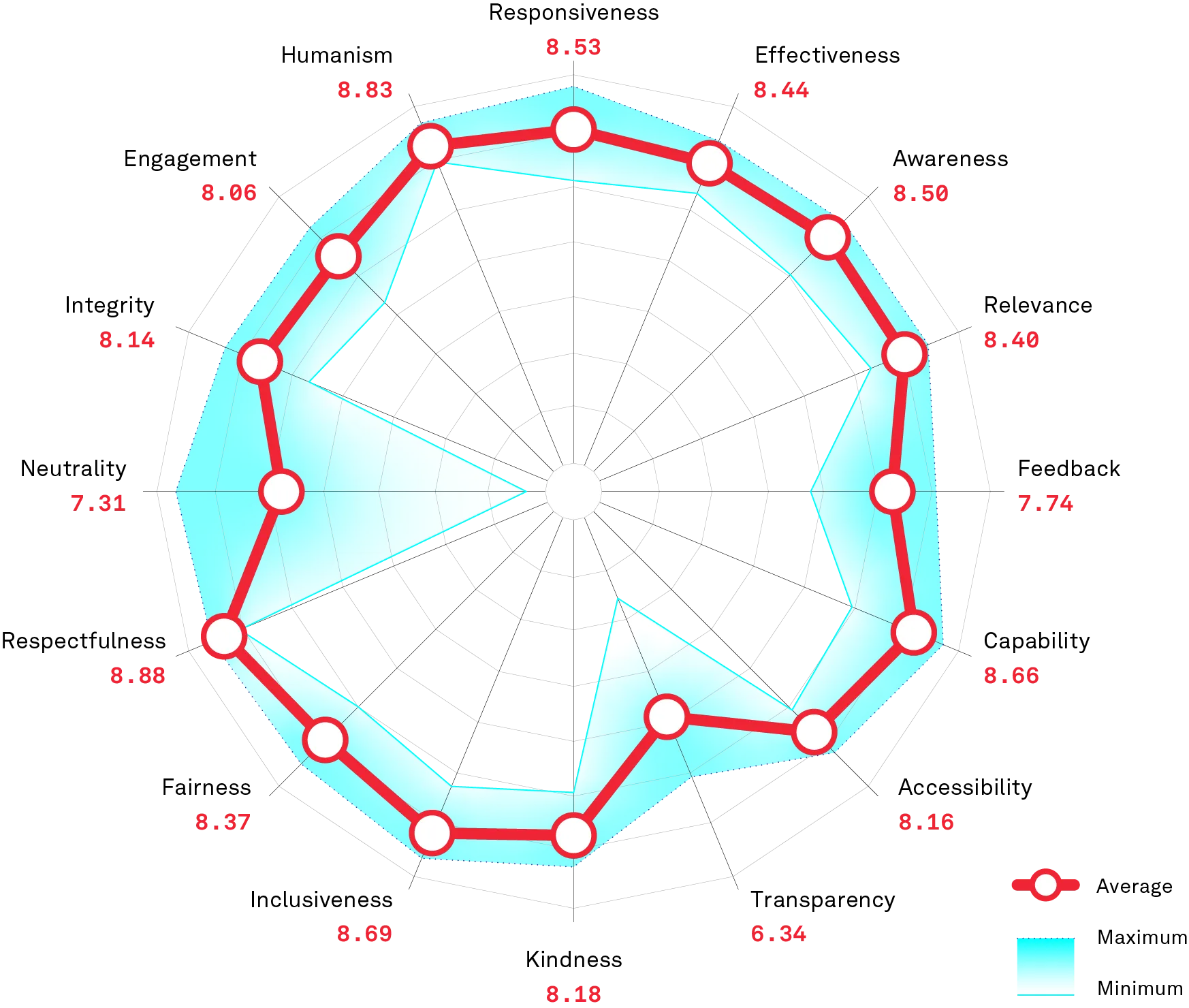
At the same time, perceptions of neutrality are increasingly fragile in today’s polarized and politically charged environments. Neutrality ranked as the second weakest driver of trust, with an average score of 7.31 out of 10. In contexts where humanitarian organizations were once broadly regarded as impartial, these assumptions are now being challenged. For example, in Zimbabwe, neutrality scores dropped sharply to 2.2 out of 10 among the general population and just 1.03 among aid recipients. In such settings, the principle of neutrality risks being undermined by contested narratives and politicized messaging, threatening the very foundation of trust.
Compounding these concerns is a limited openness to community feedback. While essential for correcting misinformation and fostering dialogue, feedback ranked as the third weakest driver of trust, with an average score of 7.74 out of 10 – indicating that many communities feel discomfort or hesitation in voicing concerns or complaints. This lack of effective feedback mechanisms hampers the ability of humanitarian actors to respond and adapt to local needs. Without clear, accessible and inclusive channels for engagement, trust becomes more vulnerable to erosion, rumours can take hold and humanitarian organizations risk being perceived as disconnected or unaccountable.
Together, these findings underscore that in today’s complex information landscape, delivering aid alone is not enough. To maintain and strengthen trust, humanitarian organ- izations must commit to transparent, neutral and responsive engagement that meets community expectations and builds resilience against misinformation.
Youth and the Trust Gap: A Growing Disconnection
Younger respondents (ages 18–30) consistently expressed lower trust in National Societies than older generations. While this may reflect broader generational shifts in how institu- tional legitimacy is perceived, it also signals a crucial vulnerability: if humanitarian actors are not perceived as trustworthy by youth – who are often more active in digital spaces – misinformation is more likely to fill the vacuum. Younger audiences may be particularly sensitive to perceived hypocrisy, opaque communication or misaligned values and less forgiving of mistakes that go unacknowledged.
The Role of Engagement in Countering Distrust
One of the strongest protective factors against erosion of trust is direct engagement. Communities with established relationships with National Societies reported trust levels somewhat higher (8.5 versus 7.8) than those without such connections. This reinforces the view that localized, participatory engagement serves as a buffer against the destabilizing effects of harmful information. By contrast, the absence of dialogue or proximity can foster suspicion – leaving humanitarian access, neutrality and security more exposed.
Gefra Fulane
Research Coordinator, CEA
IFRC, Geneva
2.7 Facts and Feelings: A Perception Challenge
In an era of increasing volumes of harmful information and rising public distrust, humanitarian organizations face a growing challenge: principled, fact-based commu- nication often struggles to compete with emotionally charged narratives, polarizing content and opinion-driven discourse. Even when – perhaps especially when – grounded in evidence and neutrality, humanitarian messaging is often drowned out by louder, more emotionally resonant voices, particularly online. This creates a significant perception challenge. Trust and integrity may be questioned and principles seen as detached from realities or lacking empathy.
The result is a trust and perception problem: neutrality, facts and rationality are increas- ingly misunderstood or mistrusted. When emotion and polarization drive engagement, even well-intentioned communications risk being reframed as political or partial. This distorts how communities perceive humanitarian work and undermines the credibility of those committed to principled humanitarian action. Navigating this landscape requires sustained community engagement, especially offline, where dialogue can foster prox- imity and trust. Online, it may also involve recognizing the limits of engagement and, in some cases, closing comment sections or refraining from responding when dialogue cannot be conducted in good faith.
Among the seven Fundamental Principles of the International Red Cross and Red Crescent Movement,31 neutrality and impartiality are often the least understood and provoke the most controversy. This is somewhat ironic, given that neutrality’s purpose is precisely to avoid entanglement in controversy. At its core, neutrality is not an end in itself, but a method to preserve trust and access in polarized or politicized environments.
Reconciling how to carry out principled humanitarian action lies at the heart of what humanitarianism is – and is not. Critiques of neutrality often argue that “in situations of injustice, neutrality only helps the oppressor, never the victim.”32 Such critiques serve as warnings against moral or political indifference and silence or passiveness in the face of injustice, violence, oppression or discrimination. At times, accusations of silence or complicity are directed at components of the Movement, especially during armed conflicts. Failing to speak can leave an information vacuum that others may fill, eroding trust. Yet speaking out can be equally fraught, as statements may be perceived as ‘taking sides’ – especially in limited, emotionally charged online comment sections. In this way, humanitarian principles are pulled into political narratives that can distort their purpose. See Chapter 7, on page 257 for more on the fundamental principles, including dilemmas such as equivalence.
Neutrality is often defined by what it is not. Overlooked is that neutrality is not neutral toward suffering. It does not mean moral indifference or denial of injustice. Rather, it means refraining from taking sides in hostilities or engaging in political, racial, religious or ideological controversies. This discipline can enable humanitarian actors to gain the confidence of all parties and access to people in need.
In today’s information age, where warring parties actively use online platforms to frame polarizing narratives and civilians engage in digital discourse, neutrality also requires refraining from being drawn into a war of words. It must be upheld both online and offline.
Ultimately, neutrality is about building trust as a means to an end: enabling the delivery of impartial humanitarian action. To safeguard it, principled humanitarian actors must consistently advocate for the protection of a neutral and impartial humanitarian space, free from political influence. States also have a key role in preserving this humanitarian space. The ability to protect and assist victims of armed conflicts, in accordance with the 1949 Geneva Conventions and their Additional Protocols, often depends on strict adherence to the principles of humanity, impartiality, neutrality and independence. These principles remain the essential tools to access the most at-risk people and to gain their trust.
That does not mean that the Movement components always ‘get it right’ in what they say – or choose not to say. Timing, consistency and clarity remain essential and difficult. These dilemmas are explored further in Chapter 7, on page 257 on the fundamental principles.
The Fundamental Principles of the Red Cross and Red Crescent Movement – humanity, impartiality, neutrality, independence, voluntary service, unity, and universality – form the ethical backbone of principled humanitarian action. Among these, neutrality and impartiality are particularly vital to ensuring trust, access and effectiveness in volatile environments. Neutrality requires that the Movement refrain from taking sides in conflicts or engaging in political, racial, religious, or ideological controversies. This principle is essential for maintaining credibility and securing access to all parties in a crisis. Impartiality, meanwhile, demands that aid be provided solely based on need, without discrimination of any kind. Together, these principles safeguard the Movement’s ability to serve vulnerable populations equitably and without bias.
However, upholding these principles is increasingly difficult. The politicization of aid, the spread of misinformation and rising social polarization have created environments where neutrality and impartiality are often misunderstood or manipulated. Humanitarian actors face difficult dilemmas such as whether to delay aid due to safety concerns, how to respond to conditional funding that excludes host populations or how to maintain neutrality while engaging with political stakeholders. For example, accepting funding that excludes certain groups can compromise impartiality and give the appearance of political bias. Similarly, a National Society publicly endorsing a political party undermines neutrality, eroding public trust and donor confidence. Even volunteers expressing political views while in uniform – or even privately on social media – may jeopardize the Movement’s perceived neutrality.
Navigating these dilemmas requires transparency, sound judgement and unwavering commitment to the seven fundamental principles. The International Red Cross and Red Crescent Movement must continuously educate stakeholders and the public about the meaning and value of principled humanitarian action, especially in today’s highly complex and polarized world.
Lessons Learned:
- Across the world, there is a growing disregard for the core principles that guide humanitarian action: humanity, neutrality, impartiality and independence.
- Increasing polarization, the politicization of aid and dehumanizing rhetoric are fuelling distrust, jeopardizing access to communities and placing the most vulnerable people at greater risk.
- Saving lives is not a political act: it is a humanitarian imperative and one that National Red Cross and Red Crescent Societies are mandated by their states to uphold.
- Neutrality and impartiality are not abstract ideals – they are essential to operating in complex, polarized environments. When these principles are ignored or weakened, the consequences extend beyond endangering aid workers – they endanger the people who rely on protection and assistance.
Anna Bowen
Regional Humanitarian Diplomacy Coordinator
IFRC, Regional Office for Europe
2.8 Responding to Harmful Information: Building Trust in Crises
Responding to harmful information requires more than increasing the volume of com- munication or correcting falsehoods. These approaches alone do not build trust and can even backfire, particularly during armed conflicts, political unrest or situations marked by discrimination. Effective responses go beyond countering narratives; they focus on disrupting harmful information and strengthening resilience at both organizational and societal levels. Trust is built through proximity, understanding, access to services and a sense of shared ownership.33 Crucially, it generally cannot be created in the middle of a crisis; it must be cultivated over time.
Trust is the foundation of humanitarian action. Without it, our services cannot reach those who need them most. It enables cooperation, open communication and gives communities the confidence to call on us in times of crisis, knowing we will preserve life and support recovery. In my time as a volunteer and Red Cross Action Team member, I have seen how trust allows us to reach the most vulnerable people without resistance, strengthen resilience and encourage participation in rebuilding and preparedness. Saving lives is not only about speed or skill, it is about the depth of trust we have built, because in emergencies, trust is truly transformative.”
The COVID-19 pandemic, the most extensive disaster in living memory, exposed deep fractures in trust within and between countries. Harmful information became a major barrier, undermining public health efforts and fuelling social division. Where trust was strong, compliance with public health measures such as social distancing and vacci- nation was higher. Where trust was weak, these same measures became politicized, contested and fragmented. The experience underscores a critical lesson: trust is foundational to crisis preparedness and response and it emerged as one of the strongest predictors of successful response. Preparedness is inherently local and built through proximity and sustained engagement, and reinforced through transparency long before crisis strikes.
Humanitarian scholar Hugo Slim observes that trust in humanitarian action is under pres- sure and organizations must confront difficult questions: Can parties to conflict trust humanitarians to be neutral and impartial? Can vulnerable people trust humanitarian organizations to deliver aid fairly and treat them with dignity? Can donor governments and generous publics be sure their support will be well spent? Can humanitarian organ- izations trust each other to work in common cause?34 Slim argues that humanitarian organizations themselves have contributed to the trust deficit. Research by Grand Challenges Canada also makes this link, noting that a lack of transparent communi- cation, conflicting mandates and failure to protect communities when needed can exacerbate distrust. These shortcomings not only erode public confidence but also create fertile ground for harmful information to thrive – further deepening scepticism and reluctance to trust humanitarian organizations.35
2.9 Transparency and Identifiability: Foundations for Trust
Digital virality is rarely organic; it is often deliberately engineered by a small number of influential accounts that dominate the attention economy, shaping beliefs and behaviours across platforms. As Singer and Brooking note: “On social media, everyone may be entitled to their own facts, but rarely do they form their own opinions. There’s someone else manufacturing the beliefs that go viral online.”36 In this environment, identifiability becomes a cornerstone of trust. Trust depends not just on what is said, but on who is saying it – whether an individual, an institution, a troll or an AI system. In particular, “It helps answer some of the questions that trust inspires us to ask: Is there a recognisable and persistent identity to the institutions and individuals behind the myriad websites one might visit?”37 Identifiability supports reputation, accountability and helps distinguish credible sources from malicious actors.38
The Bengio Report on AI safety (see Chapter 1, on page 29) warns that the rapid spread of AI-generated content could further erode trust in the information environment.General-purpose AI can now produce (and spread) both accurate and false content – including synthetic media – at an unprecedented scale. This raises the risk that people may begin to distrust information altogether. This dynamic could undermine public debate (and in democracies, democratic processes). Malicious actors can exploit this ambiguity and distrust through the so-called ‘liar’s dividend’ – dismissing real evidence as fake. However, societies may adapt over time, developing new norms and tools to evaluate credibility, much as they did with past technologies like image, video and audio editing.39 But until such norms take hold, uncertainty and distrust are likely to deepen.
For humanitarian actors, real-time monitoring of both the information and operational environment (online and offline) is essential to understand the type, narratives, impact and potential harm of harmful information. Yet the accessibility of such tools and systems available for verifying information has not kept pace with the speed and scale of harmful information – particularly given the financial constraints faced by humanitarian actors.
In humanitarian crises and beyond, images and videos are essential tools for response coordination, communicating with affected communities, advocacy and accountability. But as synthetic media and manipulated content become more accessible and harder to detect, questions around what and who to trust have never been more urgent.
‘Verifiable provenance’ can be a key part of a broader toolkit for building digital trust and resilience. This refers to the ability to cryptographically verify the origin, history and integrity of digital content. Initiatives such as the Coalition for Content Provenance and Authenticity (C2PA) are developing cross-sector open technical standards to attach secure metadata to digital files. These standards can help determine whether an image was altered, who published it and what tools were used – offering markers for authenticity and digital trust. However, provenance is not a silver bullet. It comes with its own risks, such as exposing sensitive information, enabling surveillance, increasing reliance on major platforms and proprietary tools, and reinforcing a trust gap between content that is verifiable and content that is not. This is why it is necessary to shape the provenance ecosystem – including standards, legislation and implementation – with a focus on privacy, equitable access, power dynamics and the protection of human rights.
In contexts where generative AI can hinder humanitarian relief or where digital evidence is critical to justice, verifiable provenance tools can help safeguard the truth. But these tools must be deployed in ways that uphold human rights, reflect local realities and actively support humanitarian response efforts.
Jacobo Castellanos
Coordinator, Technology, Threats and Opportunities
WITNESS
Transparency is a prerequisite for trust and a core element of the Red Cross and Red Crescent Code of Conduct. It underspins accountability by ensuring clear and honest information flows between humanitarian organisations and affected people. Transparency is embedded in key sectoral standards, including the Sphere Common Standards, which emphasise feedback mechanisms and participation, the Good Humanitarian Donorship Principles and the IFRC’s Guidelines for Emergency Assessment. Cross reference Chapter 5.
Movement‑wide commitments for community engagement and accountability.40
Concluding Remarks: Trust, Truth and Preparedness
We are already living through an information crisis. Future emergency preparedness must include equitable access to reliable information, supported by early warning sys- tems that serve all communities, especially the most at risk. Harmful information is not only eroding trust in humanitarian action, it is fuelling societal division and undermining cooperation at a time when unity is urgently needed to face global challenges.
As the World Economic Forum warned, misinformation and disinformation are no longer just communications problems – they are systemic threats that aggravate nearly everyother global risk. The 2025 Global Risks Report underscores that: “Misinformation and disinformation and societal polarization remain key current risks” and explains how the accelerating spread of false or misleading information amplifies other major risks – from state-based armed conflict to extreme weather events.41
In such a fragmented and contested information space, the voices of affected populations risk being drowned out, distorted or co-opted. Trust cannot be demanded; it must be built through repeated action, transparency, accountability and integrity. Resilience against harmful information requires more than just correcting falsehoods, it requires sustained engagement, openness and meaningful participation. Humanitarian organisations must also actively communicate who they are, what they do, their impact and why they act – making a clear, compelling case for principled humanitarian action and for the preservation of a neutral and impartial humanitarian space, free from political influence. Despite the barriers posed by polarised perceptions, principled humanitarian organisations can maintain – and even rebuild – trust and acceptance in the face of harmful information. A critical question going forward is whether trust and proximity at the community level can serve as a firewall against the spread or impact of harmful information. Cross reference Chapter 3 on page 103 and Chapter 6, on page 211 explore this question.
Asks, Aims and Recommendations
Place trust at the centre of humanitarian action by ensuring rights, inclusivity, accountability and transparency guide communication, engagement and feedback with communities.
Reduce uncertainty through timely, transparent and consistent communication and engagement before, during and after crises.
Strengthen legitimacy and accountability by aligning with community priorities and tracking trust.
Protect staff and volunteers with safeguards, skills and inclusive engagement to operate safely in contested information spaces.
Empower communities: Build two-way feedback and participation systems that allow people to voice concerns, influence decisions and counter harmful narratives.
States and policy‑makers
- Establish rights‑based policy frameworks that safeguard access to reliable information in humanitarian crises.
- Embed trust‑building into crisis preparedness and response plans.
- Invest in early‑warning and monitoring systems to detect and counter harmful narratives.
- Support National Societies in their auxiliary role, ensuring independence, impartiality, neutrality and integrity are respected.
- Ensure rapid rebuttals of falsehoods that threaten humanitarian access, action and security.
For Technology Platforms
- Detect and mitigate harmful content that undermines humanitarian action and trust.
- Share relevant data and insights safely with humanitarian actors to support real-time response.
- Ensure moderation, fact-checking and AI tools work in low-bandwidth, multilingual environments.
- Collaborate with humanitarian actors on verification and labelling mechanisms to amplify credible content.
For Humanitarian Actors
- Develop policies, guidelines, standards and metrics (e.g., Community Trust Index (CTI) and Community Engagement and Accountability (CEA)) to measure and track trust and harmful information, and guide responses.
- Embed trust as an operational asset across preparedness, response and recovery.
- Communicate transparently and inclusively, correcting falsehoods rapidly and co-creating messages with communities.
- Train staff and volunteers in rumour management, digital safety (including protection from online harassment) and culturally sensitive engagement.
- Strengthen real-time analysis of and response to community feedback, adapting visibly to concerns and sharing lessons learned to build collective resilience.
For Communities and Local Leaders
- Act as trusted intermediaries by amplifying verified information and countering rumours.
- Partner with humanitarian actors to co-create rumour-tracking and verification systems.
- Sustain trust through dialogue in schools, faith institutions and community centres.
- Engage in participatory feedback and research to ensure that responses reflect local priorities.
Endnotes
Footnotes
-
See Pariser, E. The Filter Bubble: What the Internet Is Hiding from You. (2011) ↩
-
Ibid ↩
-
Pierre, J. False: How Mistrust, Disinformation, and Motivated Reasoning Make Us Believe Things That Aren't True. (2025) p.39 ↩
-
See John Suler, Rider University psychologist (2004) referenced in Pierre, J. False: How Mistrust, Disinformation, And Motivated Reasoning Make Us Believe Things That Aren't True. (2025) p.40 ↩
-
Ibid, pp.50, 59 ↩
-
Nichols, T. The Death of Expertise: The Campaign against Established Knowledge and Why it Matters. (2024) pp. 50–58, 134–139 ↩
-
Kavanagh, J. and Rich, M.D. Truth Decay: An Initial Exploration of the Diminishing Role of Facts and Analysis in American Public Life. ↩
-
Cited in Pierre, J. False: How Mistrust, Disinformation, And Motivated Reasoning Make Us Believe Things That Aren't True, (2025), p.59 ↩
-
Rousseau, DM., Sitkin, SB., Burt, RS. et al. Not So Different After All: A Cross-Discipline View of Trust. Academy of Management Review 1998:23(3), p.395 ↩
-
Edelman. Edelman Trust Barometer (2022) ↩
-
Bavel, JJV., Baicker, K., Boggio, PS. et al. Using social and behavioural science to support COVID-19 pandemic response. Nat Hum Behav 2020:4, 460–471. https://doi.org/10.1038/s41562-020-0884-z ↩
-
Ibid, p.52 ↩
-
IFRC. World Disasters Report 2022: Trust, Equity and Local Action – Lessons from the COVID-19 pandemic to avert the next global crisis. (2022) p.68, www.ifrc.org/document/world-disasters-report-2022 ↩
-
Pierre, J. False: How Mistrust, Disinformation, And Motivated Reasoning Make Us Believe Things That Aren't True, (2025), p.45 ↩
-
Royston, G., Pakenham-Walsh, N. and Zielinski, C. Universal access to essential health information: accelerating progress towards universal health coverage and other SDG health targets. BMJ Global Health. 2020;5:e002475. https://doi.org/10.1136/bmjgh-2020-002475 ↩
-
King's College London. COVID-19 Monitor: Public attitudes and behaviours. (2020) ↩
-
Erlach, E., Nichol B, Reader S, et al. Using Community Feedback to Guide the COVID-19 Response in Sub-Saharan Africa: Red Cross and Red Crescent Approach and Lessons Learned from Ebola. Health Secur. 2021:19(1), 13–20. doi: 10.1089/hs.2020.0195 ↩
-
Pierre, J. False: How Mistrust, Disinformation, And Motivated Reasoning Make Us Believe Things That Aren't True, (2025), p.7 ↩
-
33rd International Conference of the Red Cross and Red Crescent. Resolution 6: Act Today, Shape Tomorrow (Point 1). (2019) (33IC/19/R6) https://rcrcconference.org/app/uploads/2019/12/33IC-R6-Act-today-shape-tomorrow_CLEAN_ADOPTED_en.pdf ↩
-
A dedicated commission was convened to explore how the Movement and states can work together to protect and strengthen trust in principled humanitarian action. 33rd International Conference of the Red Cross and Red Crescent. (2019) Summary Report from Commission III: Trust in Humanitarian Action. https://rcrcconference.org/app/uploads/2020/05/33IC-Commission-III-Trust-in-humanitarian-action-report_FINAL-EN.pdf ↩
-
33rd International Conference of the Red Cross and Red Crescent. (2019) Summary Report from Commission III: Trust in Humanitarian Action. https://rcrcconference.org/app/uploads/2020/05/33IC-Commission-III-Trust-in-humanitarian-action-report_FINAL-EN.pdf ↩
-
Council of Delegates of the International Red Cross and Red Crescent Movement. Resolution 5: Call for Respect and Support for Principled Humanitarian Action (2024) (CD/24/R5) ↩
-
OECD. An updated OECD framework on drivers of trust in public institutions to meet current and future challenges. (2021) p.41 https://doi.org/10.1787/b6c5478c-en ↩
-
See, for example, Slawson, N. 'Oxfam government funding cut off after Haiti scandal.' The Guardian. 16 February 2018. www.theguardian.com/world/2018/feb/16/oxfam-government-funding-cut-off-after-haiti-scandal ↩
-
Ibid ↩
-
Levitin, DJ. A Field Guide To Lies: Critical Thinking in the Information Age. (2016) pp.x–xi, 123–8, 129–130, 152–4 ↩
-
Nichols, T. The Death of Expertise: The Campaign against Established Knowledge and Why it Matters (2024) p.xiii ↩
-
As outlined in Council of Delegates. Resolution 1: Movement-wide Commitments for Community Engagement and Accountability. (2019) (CD/19/R1, Annex) ↩
-
IFRC. 'Placing communities at the centre of the Ebola response.' Article. 13 September 2019. www.ifrc.org/article/placing-communities-centre-ebola-response ↩
-
IFRC, ICRC, German Red Cross et al. Navigating Fragility, Conflict and Violence to Strengthen Community Resilience: A Handbook for Disaster Risk Reduction Practitioners. (2024) p.38 www.climatecentre.org/wp-content/uploads/Full-Handbook_RCCC-Navigating-fragility-conflict-and-violence-to-strengthen-community-resilience.pdf ↩
-
The seven fundamental principles are humanity, impartiality, neutrality, independence, voluntary service, unity and universality. These are referenced in the Preamble to the Statutes of the International Red Cross and Red Crescent Movement adopted by the 25th International Conference of the Red Cross in October 1986. ↩
-
This quote is commonly attributed to Desmond Tutu, though the exact origin is debated. Tutu, D. No Future Without Forgiveness. (Doubleday, 1999) ↩
-
IFRC. World Disasters Report 2022: Trust, Equity and Local Action. Executive summary. (2022) p.9 www.ifrc.org/document/world-disasters-report-2022 ↩
-
Slim, H. 'Trust Me – I'm a Humanitarian.' ICRC Humanitarian Law and Policy Blog. 24 October 2019. https://blogs.icrc.org/law-and-policy/2019/10/24/trust-humanitarian ↩
-
Ayala Iacucci, A. Misinformation, Disinformation, and Hate Speech in Humanitarian Contexts. Grand Challenges Canada, Creating Hope in Conflict initiative. (2024) p.31 https://humanitariangrandchallenge.org/wp-content/uploads/2024/11/MDH-Scoping-Study_Full-report.pdf ↩
-
Singer, PW. and Brooking, ET. LikeWar: The Weaponization of Social Media. (2018) p.127 ↩
-
Nissenbaum, H. Will Security Enhance Trust Online, or Supplant It? In Kramer, RM. and Cook, KS. Trust and Distrust in Organizations: Dilemmas and Approaches. (2004) p.166 ↩
-
Ibid ↩
-
Bengio, Y., Mindermann, S., Privitera, D. et al. International Scientific Report on the Safety of Advanced AI. International Scientific Panel on the Safety of Advanced AI. (2025) https://internationalaisafetyreport.org ↩
-
Council of Delegates. Resolution 1: Movement-wide Commitments for Community Engagement and Accountability. (2019) (CD/19/R1, Annex) ↩
-
World Economic Forum. Global Risks Report 2025. (2025) p.13 https://reports.weforum.org/docs/WEF_Global_Risks_Report_2025.pdf ↩